
In the fast-paced world of life sciences, success hinges on the ability to not only meet current needs but also to anticipate and enable future ones. This forward-thinking approach is a key part of capability and capacity planning, facility design and regulatory focus.
Bioconjugation of proteins, peptides, or oligonucleotides to synthetic elements has produced drug conjugates that are more effective and less toxic than traditional drugs. Recent market reports anticipate a significant expansion for the bioconjugation market, with a 15.6% annual growth rate projected to propel it from $5.27bn in 2024 to $10.86bn by 2029.
This rapidly expanding area requires a similarly expanding provision of supporting services for manufacturing and analytics.
What did Biosynth consider when expanding their facility?
The key to any successful expansion project in life science manufacturing is working with specialist suppliers and contractors across a cohesive plan. One of the many issues in building to this level of complexity is the lead times for specialist equipment and the availability of technical build teams or installers.
Here we will dive into a case study of a GMP bioconjugate facility expansion for Biosynth.
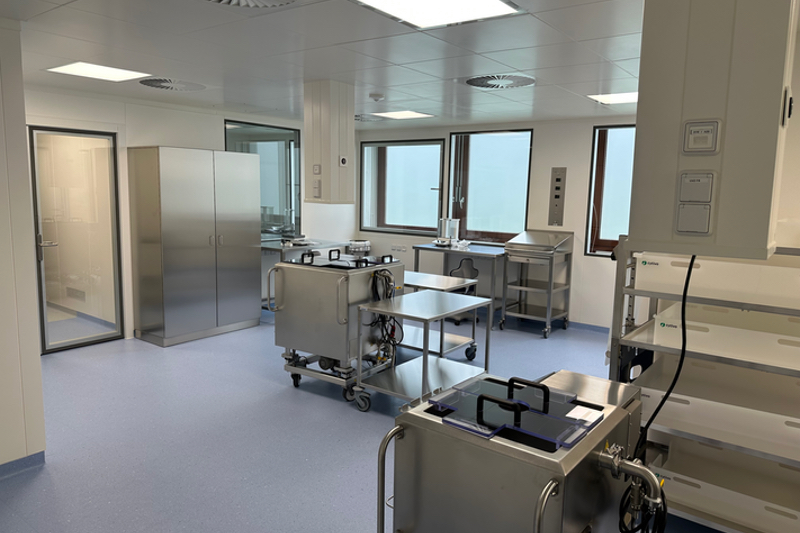
The increased demand for bioconjugate process development and manufacturing was the driving force behind Biosynth's recent strategic expansion of its Berlin facility, which houses a newly constructed GMP bioconjugation suite.
This isn't just a physical enlargement; it's a necessary evolution of capabilities, designed to support researchers as their projects progress from early-stage clinical development to commercial manufacturing. And this project of building an expanded, complex facility was certainly a collaborative, multi-contractor project. The centrepiece of the expansion is a new cleanroom suite, purpose-built to enhance production capabilities for a variety of advanced therapies, including conjugate vaccines, drugs, and polymer-based excipients.
The new facility features Grade D and C cleanrooms, with a production area of 135 sqm and a total facility area of 257 sqm. To ensure the highest level of quality and precision for sensitive tasks, these cleanrooms also contain additional laminar


