

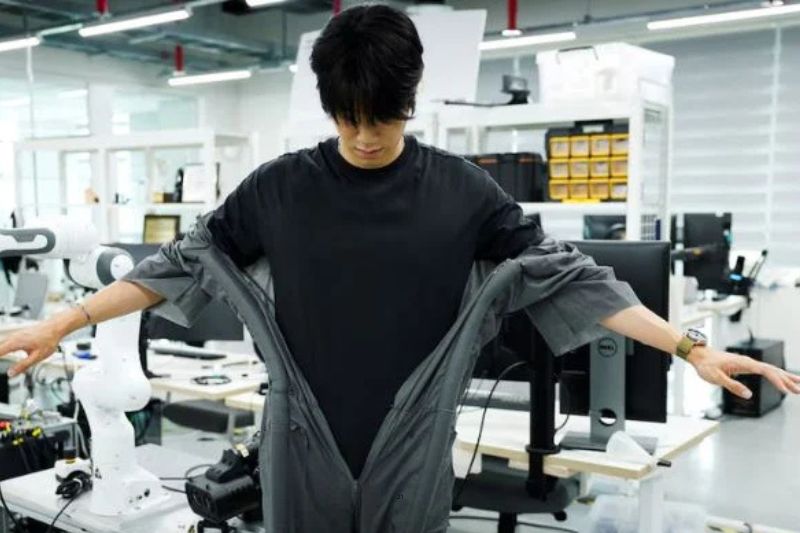
Researchers from the Korea Advanced Institute of Science and Technology (KAIST) and Stanford University have developed a soft robotic dressing system that automatically guides garments onto the wearer, offering a new approach to donning cleanroom garments and personal protective equipment (PPE).
The system integrates soft, inflatable "vine robots" directly into clothing, allowing garments to move into position without the need for external robotic arms or complex manipulation systems.
The researchers say the technology could improve dressing efficiency in environments where specialist protective clothing is routinely required, including semiconductor manufacturing, pharmaceutical production and healthcare.
Unlike conventional robotic dressing systems, which typically use robotic arms to assist users, the new approach embeds the robotic mechanism within the garment itself.
When activated by air pressure, the vine robots extend from their tips, gently pulling the clothing over the wearer's body while adapting to natural movements.
The researchers said the system uses a process that gradually turns the garment inside out as it advances, enabling it to "grow" around the body in a controlled manner while maintaining gentle contact with the wearer.
The design was inspired by climbing plants, whose tips extend continuously as they grow.
By replicating this movement, the robotic garment is able to navigate around curved surfaces without dragging fabric across the body, reducing friction and the need for precise positioning.
According to the research team, the technology could be particularly valuable in cleanroom environments, where personnel are required to wear contamination-control garments correctly and consistently before entering controlled manufacturing areas.
Beyond cleanrooms, the system could also support rapid donning of protective equipment by emergency responders and healthcare workers, while offering greater independence for elderly people and individuals with limited mobility who require assistance with dressing.
Kim Nam Gyun, a postdoctoral researcher at KAIST who helped develop the technology, said the idea emerged while cycling in the rain, when he wondered whether a raincoat could put itself on without requiring the wearer to use their hands.
The researchers believe the garment-integrated approach represents a significant departure from traditional robotic dressing systems and could pave the way for a new generation of wearable robotic technologies designed to simplify dressing across industrial, medical and assistive applications.
The research was carried out by KAIST in collaboration with Stanford University.
Further development will focus on expanding the range of garments that can incorporate the technology and refining the system for practical deployment across a variety of real-world settings.


