
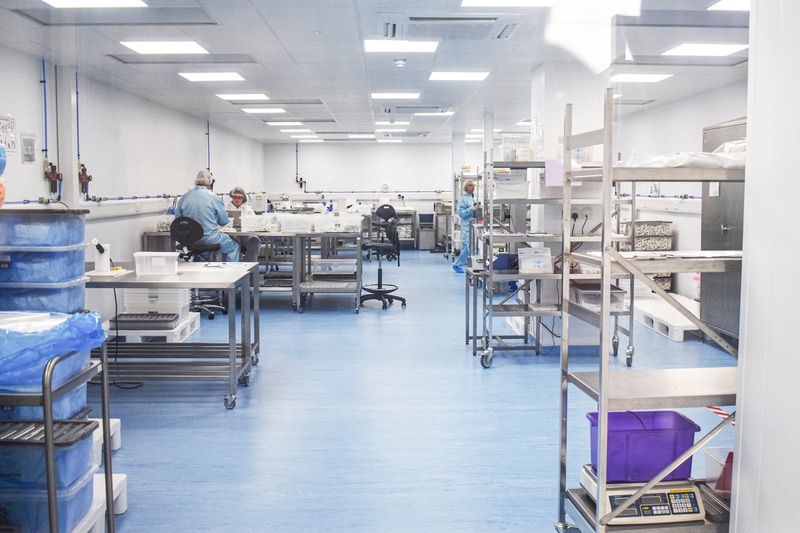
A cleanroom is only as effective as its ability to control contamination. While GMP Annex 1 and ISO 14644 provide the regulatory backbone for sterile manufacturing, the practical reality of achieving and maintaining cleanroom integrity depends on a myriad of microdecisions, from airflow strategy and personnel behaviour to furniture design, materials selection and layout.
And yet, furniture can be one of the most overlooked contamination risks.
Specialist, hygienically designed and manufactured cleanroom furniture does far more than provide work surfaces or storage. It actively contributes to contamination control, airflow performance, chemical resistance, ease of cleaning and the elimination of particle generation risks.
In an environment where every detail counts, furniture must support, not compromise, the cleanroom’s core purpose.
1. Hygiene must be the first and last consideration
Where ISO 14644 is concerned, air particle management is the starting point for every design decision. Cleanrooms must be engineered to maintain a genuinely risk-free environment, and this requires understanding not only how particles behave but also how the facility itself generates or retains them.
A contamination control strategy (CCS), aligned with GMP Annex 1, is mandatory for pharmaceutical manufacturing. It takes a holistic approach, identifying contamination risks across the entire lifecycle: from equipment design to operational controls and monitoring. Furniture forms a significant part of the “source strength” of a cleanroom. Designers must understand what contaminants the process will generate and ensure the environment never amplifies that risk.
2. Cleaning must guide design and layout decisions
One of the most effective ways to specify the right furniture is to design backwards from the cleaning regime. Anything that is difficult or time consuming to clean quickly becomes a recurring operational cost and a point of failure.
Furniture surfaces should allow for fast, complete sanitisation and easy movement for deepclean routines.
Fixed furniture presents a particular challenge. Items must either be fully sealed to walls and floors, with no opportunity for liquid ingress, or sufficiently spaced to allow cleaning personnel full and easy access. Equipment such as biosafety cabinets or scales cannot be moved once commissioned, so layout and positioning must be correct first time to allow access for cleaning and maintenance.
Cleanroom cleanliness is not just about particles; chemical, biological and electrostatic risks must also be controlled. Furniture must be both non-particle-generating and non-particle-retaining. Surfaces that attract residues or resist cleaning present unacceptable risks.
3. Furniture and airflow: layout matters
As air enters through the HVAC system, it is clean, but every object it meets makes it less clean. Annex 1 defines “First Air” as filtered air that has had no contamination intervention before reaching critical zones. If that air meets a contamination point before product contact, sterility is potentially compromised.
Furniture directly influences airflow performance and contamination risk. A core part of this is to consider where air vents are placed in a cleanroom. It may be obvious to state, but ventilation systems, once installed, are often prohibitively expensive to change so getting it right from the start is vital.
Thorough consideration of the type and placement of furniture and equipment can have a significant, positive impact on efficient air flow, helping to reduce energy consumption and, critically, reducing risk of contamination.
Even a person standing or sitting in the wrong place can block airflow, so poorly designed furniture is even more disruptive. Seemingly small design decisions matter. For example, a solid backed workbench forms an immediate airflow barrier and creates dead air space. Replacing solid panels with perforated or slatted backs supports particle dispersion. Similarly, shelves must never be solid; bar style shelves allow air to flow more freely.
4. Manoeuvrability is not optional
Auditors assess not only the visible surfaces of furniture and equipment but also the areas underneath and behind them. If furniture cannot be moved easily, cleaning teams will struggle to access critical zones and contamination will inevitably follow.
Where full mobility is required, furniture should be specifically designed to be manoeuvrable, with robust, easy clean castors which are compatible with cleaning chemicals. Importantly, mobility must not come at the compromise of stability or safety. Furniture must be lockable and completely steady so processes are not put at risk.
5. Stainless steel grade must align with the sterilisation regime
Non-shedding furniture is a critical specification for cleanrooms. Furniture must not contribute to particulate contamination, meaning fabric, wood, and untreated plastic are strictly prohibited. 316L-grade stainless steel – the gold standard for cleanrooms - contains molybdenum, a naturally occurring element which has one of the highest melting points of all elements, alongside chromium and nickel. It is more resistant to corrosion, mitigating the risk of rouging or tiger stripes while reducing contamination risk and supporting improved clean down productivity. Electropolishing can further enhance the smoothness of furniture to reduce shedding and prevent friction between laboratory gloves and coats and furniture.
Every element of every piece of equipment in your cleanroom needs to be able to withstand the harshest of chemical cleaning procedures using disinfectants such as chlorine dioxide, hydrogen peroxide, and peracetic acid. There is no point specifying a 316-grade stainless steel mobile workbench if its castors are made from Bright Zinc Plate (BZP) which can easily corrode.
6. Surface finish matters
In cleanroom environments, passivation of 316-grade stainless steel plays a crucial role in maintaining the integrity and cleanliness of surfaces. By removing impurities through passivation, the steel surface becomes more resistant to corrosion, thereby prolonging its lifespan and maintaining the desired level of cleanliness required in these controlled environments.
Electropolishing is often employed as a complementary process to passivation in the preparation of 316-grade stainless steel furniture for cleanroom environments.
When used in conjunction with passivation, electropolishing enhances the overall corrosion resistance of the stainless steel furniture by creating a more passive surface layer. By removing a thin layer of material during the electropolishing process, any remaining impurities or embedded contaminants are effectively eliminated, further reducing the risk of corrosion and ensuring the longevity of the furniture in cleanroom environments. Therefore, while passivation addresses the chemical composition of the surface, electropolishing focuses on refining the surface topography, collectively contributing to the performance and cleanliness of 316 stainless steel furniture in cleanroom settings.
7. Always consider the complete picture
Cleanrooms are complex ecosystems. Every decision, from the chemicals used for disinfection to the placement of a single workbench, affects contamination risk. A robust operating procedure is essential, but the furniture, layout and materials should actively support the CCS, not work against it.
High quality, specialist cleanroom furniture enhances airflow efficiency, reduces contamination sources, accelerates cleaning, increases compliance confidence and minimises overall risk
8. Furniture must be designed with hygiene at its core
Every item brought into a cleanroom contributes to its particle load. People and gowning systems are well recognised contributors, but furniture is one of the most underestimated contamination sources.
ISO 1464414 and 15 set out methodologies for assessing equipment suitability based on particulate and chemical emissions. Traceable testing demonstrates that poorly designed or unsuitable furniture can be a major cause of swab test failures. In practice, this means:
- Specifying materials that do not shed or retain particles
- Selecting designs that actively reduce microbiological harbourage
- Ensuring furniture does not compromise airflow or cleaning routines
- If an item could collect dirt, harbour residues or obstruct airflow, it has no place in a cleanroom.
9. Dirt traps are dealbreakers
In hygienic design, the rule is simple: no hidden ledges, no gaps, no folds, no flat horizontal surfaces. Raised welds, overlapping materials and poorly finished joints create harbourage points that cleaning agents may never fully reach.
Even sinks can become contamination risks if water stagnates.
High quality cleanroom furniture should therefore feature seamless construction, fully welded, ridgeless joints, rounded corners and internal angles designed for complete cleanability.
If contaminants can accumulate, they will. Eliminating dirt traps at the design stage is nonnegotiable.
When every element works together, the cleanroom operates more efficiently, safely and reliably.


