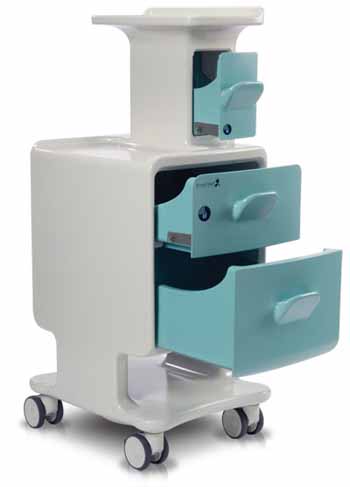
The Chesterfield Royal is the first UK hospital to take delivery of new anti-HCAI bedside lockers
The bedside units, featuring a patented design, have entirely smooth surfaces with no joins or crevices and feature removable drawers allowing them to be cleaned thoroughly in less than a minute.
Many bedside units currently in use in hospitals have square edges, cervices and joins that can harbour germs making cleaning difficult, as well as lacking the flexibility needed in the modern healthcare environment. Patients find that current designs, many with deep drawers are hard to access from the bed, with less mobile patients often having to ask for assistance when accessing their belongings, placing additional pressures on nursing staff.
Developed as a result of the UK Design Council and Department of Health’s “Design Bugs Out” project, the challenge for manufacturer Bristol Maid and designer Kinneir Dufort was to bring the traditional bedside cabinet into the 21st century. They focused not only on providing a flexible storage area to satisfy the needs of the patient, but also on a product that is easy to clean and assists with reducing Healthcare Associated Infections (HCAIs) around patient beds.
After extensive user research and consultation with patients, medical staff, infection control, pharmacists, cleaners and matrons to identify the key features that were required, the new bedside cabinet is made from a durable, easy clean polymer that reduces the number of hard to reach corners and surfaces without cutting down patient storage.
The top section allows staff to dispense drugs or write up their notes; it also has key features such as raised sides so that any spillages can be contained on the unit and easily wiped clean.
The backless design also eliminates hard-to-clean areas with a continuous moulded form, smooth surfaces with no joints, junctions or sharp corners to harbour germs.
Patient storage is provided through: two upper shelves which are easily accessible from the bed, one shallow, one deep drawer, a lower open storage area and clothes hooks positioned on the rear of the unit.
An innovative 'reversible drawer' design was incorporated, allowing the cabinet to be used on either side of the bed by simply removing the drawers and slotting them into place through the other side of the unit; also providing assistance when cleaning.
Both drawers can be fitted with concealed RFID controlled electronic locks suitable for use in conjunction with “Self Administration Programmes”, as well as allowing the secure storage of patient's possessions.