

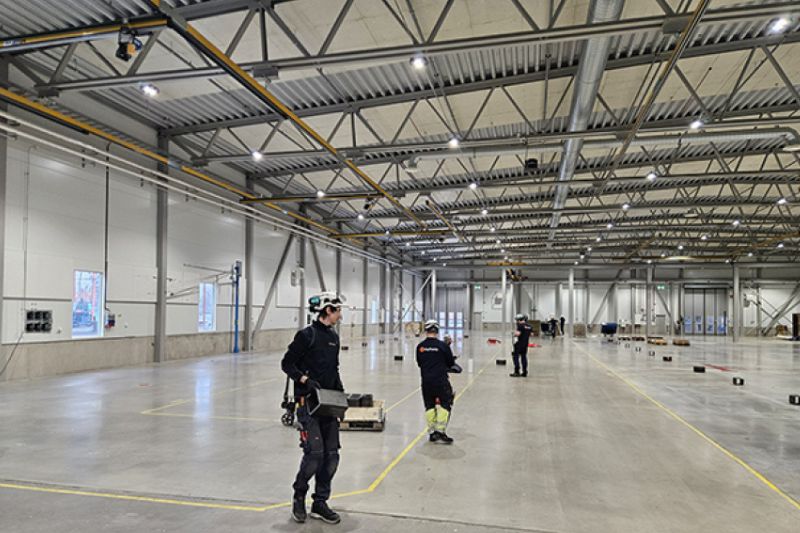
KeyPlants has doubled its modular prefabrication capacity following the opening of a new production facility in Götene, Sweden.
The new site, now operational alongside the company’s long-standing Emtunga facility, enables the delivery of twice the previous production volume across off-site construction projects.
The company said at the end of last year that an additional two to three major projects are already in the pipeline.
This additional facility allows the firm to either scale up project size or run multiple cleanroom and pharmaceutical facility builds, while maintaining established delivery timelines.
“To support the increased capacity, KeyPlants has established around 80 new workplaces in Götene, bringing together specialists across all disciplines involved in project delivery,” said Niklas Rosman, Head of Operations and Engineering at KeyPlants.
Designed to mirror the capabilities of the existing Emtunga plant, the Götene facility supports full off-site integration of critical systems, including cleanrooms, process equipment, clean piping and HVAC infrastructure.
Pre-installation and testing are also carried out in-factory, ensuring facilities arrive on site ready for rapid installation and commissioning.
The expansion responds to growing global demand for modular manufacturing environments across the life sciences and advanced technology sectors, where off-site construction is increasingly used to accelerate project delivery and reduce time to market.
According to the company, the additional capacity strengthens its ability to deliver industrialised, GMP-compliant production environments at scale, supported by controlled production spaces at the new site.
In a Cleanroom Technology interview with KeyPlants in 2024, the company also said that around 70% of its total carbon dioxide emissions are linked to the purchase and manufacturing of construction materials, including steel and concrete, within its supply chain.


