
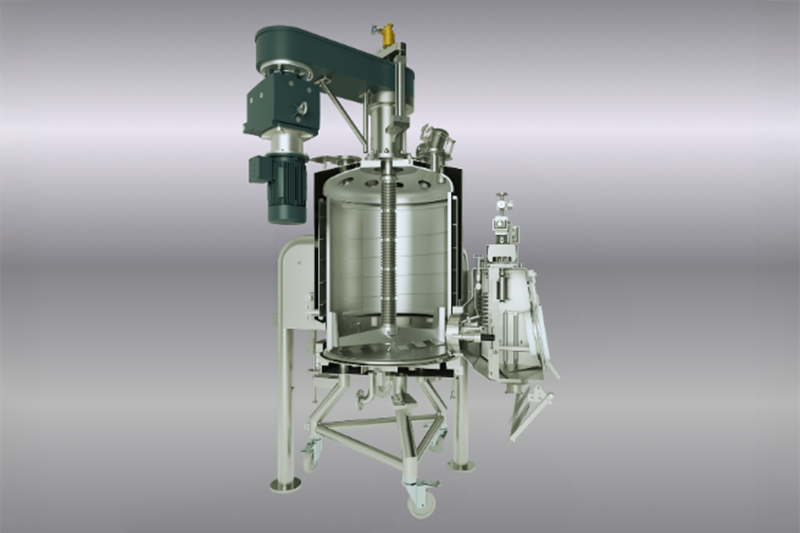
Conventional workflows require moving wet cake between units, increasing the risk of contamination, material loss, and inefficiency. The ANFD eliminates this transfer, allowing processors to filter slurries and discharge dry powder without breaking containment. This integrated system improves product purity, supports automation, and strengthens process safety.
To unlock the full benefits of the agitated Nutsche filter dryer (efficiency, purity, and yield), each process stage must be optimised. Fine-tuning both dewatering and drying steps within the same vessel ensures that cycle times are minimised and scale-up performance remains predictable.
Optimising Dewatering (Filtration and Cake Preparation)
Filtration is the primary step where a liquid (filtrate) is separated from solid particles, which accumulate to form a filter cake on the bottom filter medium. Further “preparation” of the cake is conducted via further washing and smoothing/compression. The foundation of effective drying is, therefore, maximum solvent removal during dewatering. Optimising this step reduces the energy load and duration required for thermal drying while improving process uniformity.
Key optimisation techniques include:
- Mechanical Manipulation – Using the agitator blade for smoothing or compressing the cake to expel unbound liquid and achieve uniform thickness.
- Product Washing – The purpose of washing is to remove impurities, residual solvents, or the liquid trapped within the filter cake, before moving into a drying phase with a solvent that’s easier to evaporate.
- Convective Pre-Drying (Blow-Through) – Passing an inert gas (commonly nitrogen) through the wet cake post-filtration. The resulting pressure-driven flow removes additional solvent without the need for elevated temperatures.
The blow-through stage is crucial for optimal agitation and drying. Its performance can be modelled using the Carman–Koseny equation, which relates the pressure differential (ΔP) across the cake to the gas flow rate (vₛ) and cake thickness (L). By plotting ΔP versus vₛ·L, operators can predict solvent removal efficiency and scale the process accurately(1).
Maintaining uniform gas flow through the cake is equally important. Periodic cake smoothing prevents channeling, ensuring even mass transfer throughout the bed.
1. Maximising Heat Transfer and Homogeneity
Heat transfer within the agitated Nutsche filter-dryer is influenced by the overall heat transfer coefficient, temperature differential, surface area, and mixing intensity. Agitation plays an important role by continuously disrupting the powder bed, reducing thermal boundary resistance, and promoting temperature uniformity:
- Gradually increase jacket temperature to avoid overheating near the vessel wall and prevent fouling (dry coating formation).
- Use predictive tools to optimise intermittent mixing schemes, which improve heat transfer while limiting mechanical stress.
2. Avoiding Agglomeration and Attrition
During drying, agitation must be carefully balanced to promote even heating without damaging the particles:
- Agglomeration Risk: Avoid agitation when the cake is above its critical moisture content (CMC), or “sticky point.” At this stage, solvent-laden cake is prone to clumping and hard lump formation. Experimentally, the sticky point can be determined by measuring peak torque during agitation.
- Attrition Risk: Once the cake is drier, controlled agitation becomes beneficial. Low speeds may lead to particle agglomeration, while high speeds risk excessive breakage. Establishing the optimal agitation profile is best achieved through laboratory testing and validated modelling.
Optimisation of mixing duration and intensity within this regime minimises attrition while maintaining high heat and mass transfer efficiency.
Learn More About ANFD Vessel Optimisation
By optimising both dewatering and drying stages inside the same ANFD vessel, manufacturers can dramatically improve process efficiency, reduce energy use, and maintain consistent product quality. Integrated operation reduces handling and contamination risk while shortening cycle times and enhancing yield.
Agitated Nutsche filter dryer technology demonstrates high engineering efficiency, merging solid-liquid separation and drying into a single, automated, closed process. Predictive simulation further strengthens process control by accurately estimating drying time, solvent removal rates, and final product quality.
Explore how agitated Nutsche filter dryer ANFD systems can address throughput, purity, and scale-up challenges in your solid-liquid separation workflows. Powder Systems Ltd. (PSL) offer a range of filtration and drying solutions, including advanced agitated Nutsche filter dryers designed for high-performance, safe, and repeatable processing.
References
Birch, M, Marsiano, I. Understanding and Avoidance of Agglomeration During Drying Processes: A Case Study. Pfizer Worldwide Research & Development.