

The shift toward continuous manufacturing in sterile pharmaceutical production is reshaping how cleanroom processes are designed, executed and controlled. As manufacturers seek to increase throughput, attention is turning not only to core production steps, but also to the supporting processes that enable them.
Environmental monitoring (EM) is one such area. While essential for demonstrating environmental control, EM workflows can introduce operational inefficiencies and contamination risks; particularly when it comes to the transfer of microbiological media into critical environments.
At the same time, the updated EU GMP Annex 1 has raised expectations around contamination control, placing greater emphasis on risk-based approaches, minimising interventions, and ensuring that all aspects of the process are aligned within a comprehensive Contamination Control Strategy (CCS).
In this evolving landscape, the use of gamma-irradiated prepared media in sealed beta bags for rapid transfer ports is emerging as a practical solution that supports both compliance and operational efficiency.
EM in the era of continuous manufacturing
EM in Grade A critical zones within RABS or isolator systems, requires a high degree of control and consistency, particularly as aseptic manufacturing models evolve toward continuous or semi-continuous production.
As monitoring frequency increases and production schedules become more demanding, manufacturers need EM workflows that can keep pace and operate with minimal disruption.
This is particularly evident in the transfer of microbiological media into critical environments, which in many facilities remains a multi-step process involving repeated handling and decontamination stages (see Info Box 1).
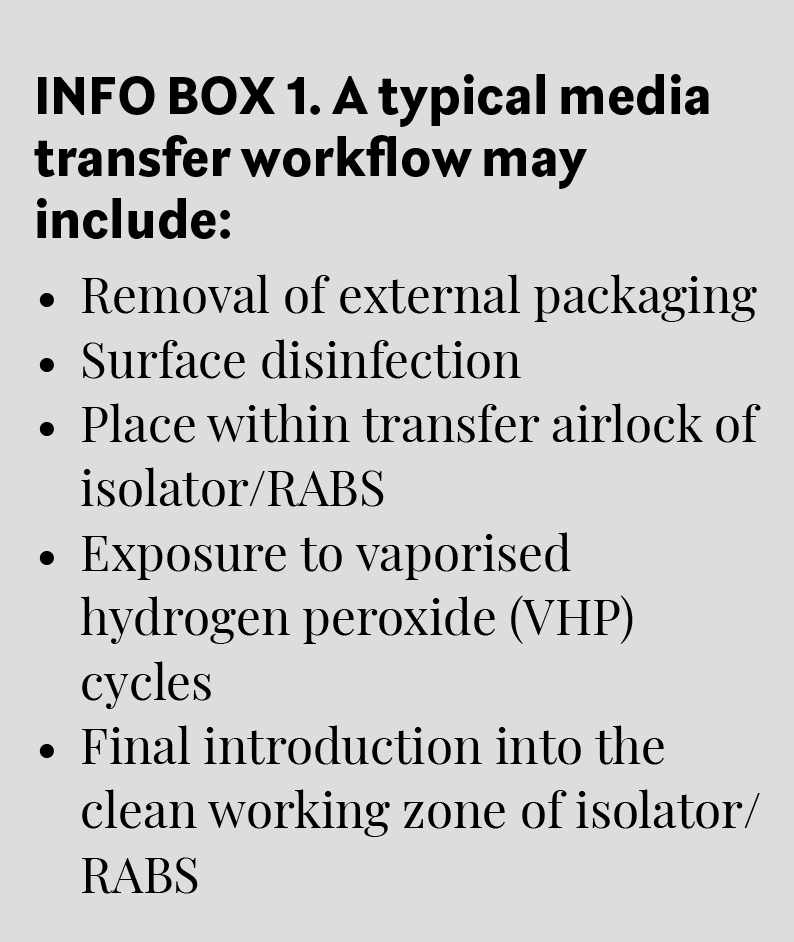
Each step introduces time, operator intervention, and variability, creating avoidable inefficiencies and increasing the risk of disruption to production.
Operational constraints: time, intervention, and variability
One of the most significant constraints in compendial EM workflows is the reliance on repeated decontamination and handling steps. Vaporised hydrogen peroxide (VHP) cycles, commonly used to decontaminate materials in isolators or RABS, are both time- and resource-intensive. Each cycle can take up to 30 minutes, and when iterated across a production schedule, can accumulate into several hours of lost operational time per day.
In facilities where conventionally packaged media require an additional decontamination step before use in isolators or RABS, this can add time, handling, and operational complexity to the EM workflow. Repeated handling and transfer of materials can lead to inconsistency and operational risks.
Together, these factors introduce variability into what should be a highly controlled process. In continuous manufacturing, this can constrain both productivity and contamination control.
A closed-system approach to media transfer
To address these EM workflow challenges, there is growing interest in closed-system solutions that simplify and standardise the transfer of consumables into critical aseptic testing environments.
Gamma-irradiated prepared media supplied within sealed beta bags, such as Redipor (registered trademark) BetaBags from AnalytiChem (Top image), offers one such approach. These connect directly to compatible alpha-port systems, enabling repeated sealed transfer within a validated workflow with reduced handling and without additional decontamination steps.
This closed-system design provides several key advantages:
- Elimination of multiple transfer steps, reducing complexity and risk
- Removal of repeated VHP cycles for media introduction, saving time and resources
- Reduction in operator intervention, supporting aseptic best practices
- Improved consistency, through standardised, ready-to-use formats
By streamlining the transfer process, using beta bags for repeated media transfer helps align EM workflows with the broader goals of continuous or high-throughput aseptic manufacturing.
Strengthening Contamination Control Strategies
The revised Annex 1 guidance places strong emphasis on the development and implementation of a holistic CCS. This requires manufacturers to identify, assess, and mitigate risks across all aspects of their operations; including materials transfer and EM.
Prepared media beta bags support this strategy in several important ways:
Minimising intervention in critical environments: Annex 1 highlights the need to reduce manual interactions wherever possible. By enabling direct transfer into isolators, beta bags significantly reduce the number of operator interventions required.
Maintaining system integrity through sealed transfer: Closed transfer systems are well aligned with Annex 1 expectations around minimising interventions, protecting barrier integrity and controlling contamination risks during material transfer. Beta bags provide a validated, sealed pathway for introducing consumables into Grade A environments, helping to maintain environmental integrity.
Reducing contamination risk at source: By eliminating handling steps and reducing exposure to external environments, beta bags help lower the risk of introducing contaminants during the transfer process.
Supporting consistency and reproducibility: Standardised, gamma-irradiated prepared media supports consistent supplied monitoring consumables and helps standardise the media introduction step within the EM workflow.
In combination, these benefits contribute to a more robust and defensible CCS, aligned with both regulatory expectations and operational realities.
Unlocking productivity in aseptic manufacturing
While contamination control remains the primary driver, the productivity benefits of beta bag systems are equally significant, particularly in facilities transitioning to continuous or high-throughput aseptic manufacturing.
By reducing or eliminating VHP cycles associated with media transfer, manufacturers can:
- Minimise process interruptions, enabling smoother production flow
- Increase available manufacturing time, improving facility utilisation
- Enhance scheduling flexibility, allowing additional batches to be processed
In practical terms, the cumulative time savings can be substantial. Removing multiple VHP cycles of up to 30 minutes each, from a daily schedule can free up several hours of production time, increasing overall capacity and improving operational responsiveness.
Reducing validation complexity
Validation is another area where beta bag systems can deliver meaningful benefits. Traditional transfer methods often require the validation of decontamination processes for different materials, along with revalidation when introducing new products or packaging formats, adding to both the operational and administrative burden.
In contrast, once a beta bag transfer process has been qualified for a defined application, it may reduce ongoing validation and operational burden compared with more manual transfer approaches, while remaining subject to normal site change control and risk assessment. This reduces the overall validation workload, lowers associated costs, and simplifies change management.
For facilities handling multiple products or operating in flexible manufacturing environments, this reduction in validation burden can be particularly valuable.
Tailoring solutions to specific workflows
Flexibility is an important consideration in EM workflows, where requirements can vary depending on facility design, process type, and regulatory expectations. Prepared media in beta bags can be customised to support these diverse needs, including:
- Different media formulations, such as those containing neutralisers
- Variable plate quantities per pack, aligned with sampling strategies
- Multiple wrapping configurations to suit different transfer protocols
- Option of locking plates for sample security
This level of customisation enables manufacturers to optimise their EM workflows, reducing waste, improving efficiency, and ensuring that consumables are aligned with specific process requirements.
In addition to operational flexibility, these systems can also support organisational sustainability goals. By reducing reliance on repeated VHP cycles, minimising excess packaging, and enabling more efficient use of prepared media, beta bag systems can help lower both material waste and chemical usage.
Features such as extended shelf-life at room temperature and GS1-compliant barcoding further support inventory control, traceability, and integration with automated inventory management systems.
Unlocking future-proof aseptic processes
As pharma manufacturing continues to evolve, the expectations placed on EM workflows look set to increase. Greater emphasis on continuous production, real-time monitoring, and integrated quality systems will require processes that are both robust and adaptable.
In this context, solutions that reduce complexity, minimise risk and enhance operational efficiency will play a critical role in shaping the future of cleanroom operations. Prepared media beta bags represent a simple but impactful innovation, delivering benefits across contamination control, productivity, sustainability, and compliance.
Solutions such as AnalytiChem’s Redipor BetaBag highlight how a targeted change to a routine process can deliver measurable impact: reducing intervention, supporting contamination control strategies, and enabling more efficient, continuous-ready EM workflows.
Optimising the details that matter
In aseptic manufacturing, success is often driven by incremental improvements rather than a single breakthrough. By rethinking how microbiological media is introduced into controlled environments, manufacturers can remove inefficiencies, reduce risk and better align their operations with the demands of continuous manufacturing.
Prepared media beta bags offer a practical, scalable way to achieve these goals, helping to transform a routine process into a source of competitive advantage, while supporting the broader objectives of contamination control, sustainability and operational excellence.


