
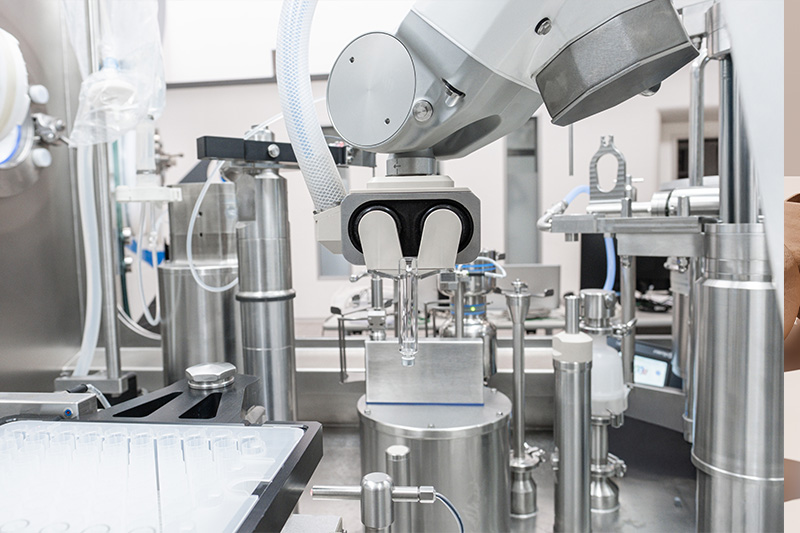
Steriline, a company highly specialised in the manufacture of complete lines for the sterile filling of injectable and ophthalmic products for pharmaceutical companies worldwide, will be exhibiting at the next edition of CPhI, which will take place in Milan from 6-8 October 2026. At the Steriline stand (Hall 9, Stand 9A58), visitors will be able to see the capabilities of the new VKSFCM11 robotic filling line, an ideal solution for all pharmaceutical companies seeking to improve production efficiency, combining high process flexibility with the ‘zero-loss’ concept and full compliance with Annex 1, thanks also to the integration of state-of-the-art Artificial Intelligence (AI) applications.
The VKSFCM11 robotic solution under an isolator, which will be presented at the stand – ideal for small batches and for cell and gene therapies – incorporates the new OmniAI Vision system, a platform developed by Steriline based on the integrated use of cameras and AI-driven data management and processing. This improves compliance with Annex 1 by making the line’s design more efficient, reducing the number of sensors and cameras within it and optimising the laminar flow.
“Thanks to AI, we can analyse images from the cameras positioned within the production line,” says Alessandro Caprioli, Product Development Director at Steriline. “These cameras, situated away from the filling, capping and crimping area, adhere to the ‘first air’ concept, provide wider fields of view and enable us to monitor a greater number of functions, offering clear benefits for our customers.”
The VKSFCM11 is one of the solutions designed to process products with high and very high added value, regardless of the type of container. Thanks to its flexibility, it is also ideal for the study, research and development phases, as well as for pilot batches and small production runs.
We are proud to showcase this solution to visitors from all over the world; it combines the ‘zero-loss’ approach, a high degree of flexibility, and the integration of Artificial Intelligence
“The solution we are showcasing at CPhI 2026 is perfectly in line with the aim that has long distinguished Steriline, namely to offer increasingly future-oriented solutions capable of responding precisely to the demands and needs of an ever-evolving market such as the one we serve,” says Federico Fumagalli, Chief Sales Officer at Steriline. “For this reason, Steriline has been developing AI-based applications for some years now, and the VKSFCM11 is the most recent and concrete example of this.”
“We are proud to showcase this solution to visitors from all over the world; it combines the ‘zero-loss’ approach, a high degree of flexibility, and the integration of Artificial Intelligence,” says Giovanni Panzeri, Sales Area Manager at Steriline. “The VKSFCM11 is particularly interesting because, first and foremost, it meets all the requirements of Annex 1; furthermore, the integration of AI enables the analysis of a greater volume of data, thus allowing different checks to be carried out simultaneously but at a significantly lower computational cost.”
At CPHI 2026, alongside the new OmniAI Vision system, OptiLAIN will also be unveiled – a platform dedicated to the continuous monitoring of the overall condition of the line and predictive maintenance. The two technologies complement each other perfectly and work in synergy: OmniAI Vision monitors the process from the outside, via cameras, while OptiLAIN monitors it from the inside, using all the other sensors.
In short, OmniAI Vision and OptiLAIN represent two complementary components of a broader strategy for the digitalisation of fill-finish lines, in which images, data and algorithms work together to improve process control, support regulatory compliance and reduce operational risk; they are the result of many years of research carried out according to an Open Innovation model.