
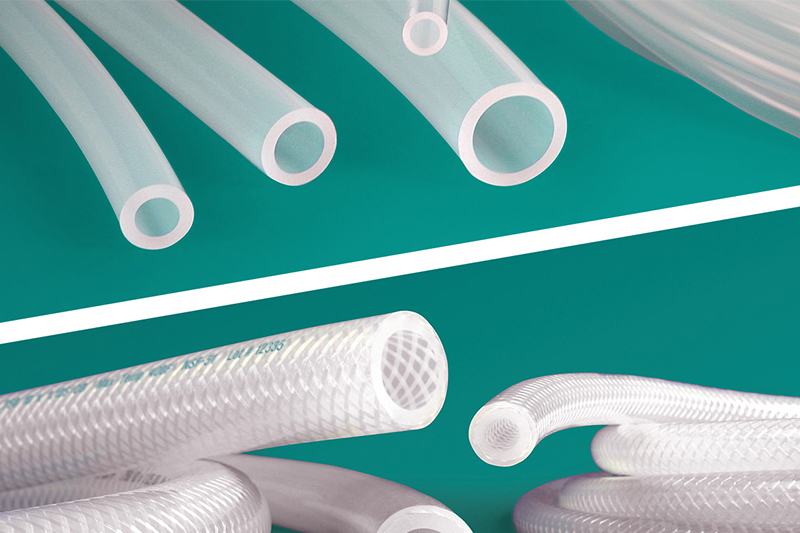
The primary difference between tubing and hose: a hose will always have some form of reinforcement while tubing is unreinforced. Depending on the design of the reinforcement, there can be multiple uses or applications in which the hose can be used. Take for example AdvantaSil® APSH-Braided, this product uses a polyester cross braid to reinforce the tensile strength and the radial burst strength of the silicone. APSH will excel in applications where the fluids being transferred can experience elevated internal pressures such as in TFF (Tangential Flow Filtration) or PUPSIT (Pre-Use Post-Sterilization Integrity Testing) assemblies. Another reinforcement strategy is used in AdvantaSil® APSW. The wire reinforcement coupled with the polyester mesh provides resistance to vacuum pressures.
As for tubing, in most instances this product lends itself to lighter duty applications. While still versatile, and capable of withstanding both positive and negative pressures, they typically will not compare to identical materials in hose constructions. Like hoses, tubing is offered a range of in various material compositions. A benefit to tubing is that it can be produced with smaller internal diameters than hoses. Tubing is also more flexible for tight geometries in capital equipment. Depending on the material, it can also be used in pumping applications. Lastly, tubing can be overloaded for more secure connections.
The extremes of your application should be carefully considered when choosing the material(s) and construction(s) of your tubing or hose. Will your system require a constant high pressure, vacuum, or will it only be seeing variance in the pressure occasionally? Is it going to be placed in a high traffic area where it may be prone to crushing or kinking? Are you simply looking to transport fluids or gas from point A to point B with minimal change in flow rate or pressure?
Our team of experts is committed to providing high-quality products, personalised support, and innovative solutions to help you achieve your fluid transfer goals. Contact us today to learn more about our bioprocess fluid transfer solutions.
Article by Field Applications Specialist, Kendall V. Horst, MSc