The biopharmaceutical industry faces an ongoing challenge: securing GMP-compliant manufacturing space without the cost and time of building a facility or the trade-offs of outsourcing.
As development timelines shorten and capital becomes more constrained, companies are turning to cleanroom rental models instead of building dedicated infrastructure.
The market has evolved into distinct models, each with different advantages and limitations.
This article focuses on two primary options available to US biopharmaceutical manufacturers: cleanroom hosting and modular cleanroom rentals.
Cleanroom hosting
Cleanroom hosting provides dedicated GMP cleanroom space within multi-tenant facilities, enabling companies to retain direct control over their manufacturing processes. Unlike traditional contract manufacturing, the innovator operates the process while the facility partner manages infrastructure, environmental monitoring, quality systems, and compliance.
Companies license cleanroom suites as their manufacturing space for a defined period. The hosting provider supplies the infrastructure, including ISO-classified cleanrooms, HVAC systems, utilities, gowning areas, storage, and waste handling. The provider also manages environmental monitoring and GMP cleaning to ensure compliance.
The facility operates under established quality systems, while the client manages its own manufacturing equipment, processes, and batch records. This structure enables companies to execute independently while relying on a compliant operational backbone.
Flexibility is built into the model. Some companies operate entirely with their own teams, while others leverage available support across technical operations, quality, and process development, depending on their needs.
Some companies operate entirely with their own teams, while others leverage available support
Companies can begin operations within 4 to 6 weeks, compared to 18 to 24 months for a new facility and several months for CDMO onboarding and technology transfer. Capital requirements are also reduced, as costs shift from facility construction to operational expenses.
Advantages
The primary benefit of cleanroom hosting is control. Companies maintain ownership of their process, equipment, and production planning while operating within an established GMP framework. This is valuable for organisations working with novel or proprietary processes where manufacturing knowledge is an important asset.
Speed to execution is another major advantage. Programmes can move from agreement to manufacturing in weeks, allowing faster development timelines. As demand increases, companies can expand into additional cleanroom space within the same facility network without disruptive transitions.
Financial flexibility is also improved. Instead of committing capital to build infrastructure, companies can preserve resources for research and development while accessing cleanroom capacity as needed.
Hosting environments operate under established quality systems with inspection history, providing confidence in compliance and reducing the burden of building systems from scratch.
Limitations
Location is one constraint. Cleanroom hosting facilities are concentrated in major biotechnology hubs, which can work for most companies but may not suit every geographic need.
From a design perspective, hosting environments are structured for flexibility within defined parameters. Cleanrooms are built with specific dimensions and can be expanded by removing wall panels to increase the footprint.
Scaling to accommodate larger bioreactors or processes that require large amounts of WFI may require more extensive modifications, particularly where ceiling height, utilities, and process integration become critical.
Modular cleanroom rentals
Modular cleanroom rentals provide temporary infrastructure through mobile or prefabricated cleanroom units. These systems are designed for rapid deployment and short-term use, offering a different approach to accessing GMP space.
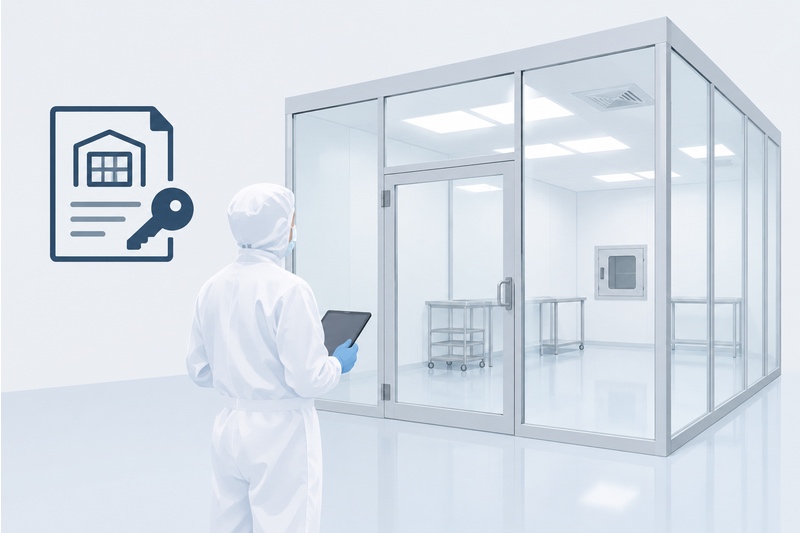
Modular cleanrooms are self-contained units, often built within transportable structures equipped with HVAC systems, filtration, airlocks, and core utilities. They can be deployed to a hospital, existing facility, or remote location and become operational once connected to required utilities.
This model allows companies to establish cleanroom capacity for a defined period
This model allows companies to establish cleanroom capacity for a defined period without making permanent modifications to their facilities. Once the project is complete, the unit can be removed and the space returned to its original state.
Advantages
Deployment speed is one of the most compelling aspects of modular cleanrooms. Units can become operational within one to two weeks, making them well-suited for urgent manufacturing needs or temporary capacity constraints.
Flexibility in location is another benefit. Modular units can be installed where needed, including at research sites, warehouses, or remote locations. This makes them useful for decentralised manufacturing or for clinical programmes that require proximity to specific populations.
For short-term projects, modular cleanrooms can also be cost-effective. They eliminate the need for long-term infrastructure investments and allow companies to pay only for the duration of use. Because these systems are self-contained, they require minimal facility modifications beyond utility connections, reducing complexity and disruption.
Limitations
The primary limitation of modular cleanrooms is space. These units offer significantly less capacity than traditional facilities and are not well-suited for mid-to-large-scale manufacturing or complex workflows. Their use is generally limited to small-scale processes or focused applications.
Operational responsibility is another major factor. Companies using modular cleanrooms must establish and maintain their own environmental monitoring programmes, quality systems, documentation, and compliance. This requires internal GMP expertise and operational maturity.
Design flexibility is also constrained by the modular unit’s structure. While different configurations are available, the ability to support specialised processes or reconfigure layouts is limited compared to the modular scalability that is integrated into permanent facility environments.
Selecting the right model
Choosing between cleanroom hosting and modular rental depends on operational needs, internal capabilities, and the nature of the manufacturing programme.
Internal experience is often the determining factor. Companies with established GMP operations teams and quality systems may be able to operate effectively in either model. Organisations that require infrastructure support, environmental monitoring, and quality oversight tend to benefit more from cleanroom hosting.
Cleanroom hosting and modular rentals each serve distinct use cases
Process complexity also plays a major role. Programmes that require multiple cleanroom suites, specialised equipment, or integrated workflows generally exceed the capabilities of modular units and are better suited to hosting environments. Simpler processes may be accommodated within modular systems.
Geographic considerations can also influence the decision. Hosting facilities are located in established biotechnology regions, while modular systems can be deployed in areas with limited infrastructure.
Financial strategy is another important factor. Both models avoid the cost of building a facility, but they differ in how responsibilities are distributed. Hosting includes infrastructure management within the service, while modular rentals shift those responsibilities to the company.
Conclusion
Cleanroom rental models provide critical alternatives to traditional facility construction and outsourcing. Cleanroom hosting and modular rentals each serve distinct use cases and offer meaningful benefits when applied appropriately.
Cleanroom hosting is best suited for companies seeking to maintain control of their manufacturing processes while leveraging an established GMP infrastructure and support system. It provides speed, scalability, and operational simplicity for programmes that require a stable and compliant environment.
Cleanroom rentals offer rapid, flexible solutions for short-term or highly specific needs, particularly where location or timing is a constraint. They require a higher level of internal capability and are limited in scale.
As the industry continues evolving, companies are combining access to infrastructure with control over their processes. Selecting the right model requires aligning operational needs, technical requirements, and long-term strategy with each approach’s capabilities.