

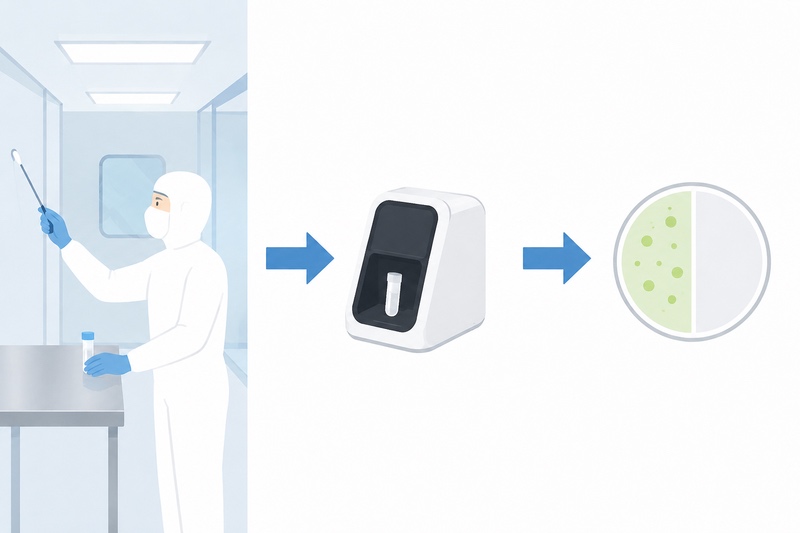
RMM, or Rapid Microbial Methods, are systems of microbial contamination monitoring that are replacing or adding to traditional culture-based testing. The idea behind these technologies is that they allow for near-real-time, or at least faster, monitoring of air, surfaces, and personnel. These systems also normally have a level of automation or data processing that increases accuracy and reduces the risk of human error.
Culture-based methods take swabs from the environment and grow them on a petri dish to examine the microbes present in a room. These methods are lengthy by nature, with results relying on the growth cycle of the contamination. With RMM, the time to detect microbial contamination can be slashed, and the benefits of this speak for themselves.
What are some common RMM techniques?
One of the most common RMM techniques is ATP bioluminescence, which detects adenosine triphosphate (ATP). This is the “universal energy currency compound” that is present in all living cells. The concept for detection is that when ATP reacts with a luciferase enzyme, light is produced and measured. Results can be generated in minutes with this method for biological residue, and it is frequently used for surface and equipment cleanliness verification, though it cannot distinguish microbial ATP from other organic residues.
Another common method is fluorescent staining, which includes Direct Epifluorescent Filter Technique (DEFT). This method involves capturing microorganisms on a membrane, staining them, and examining them under a fluorescence microscope. These methods are faster than plate counts, but slower than APT methods, and they may also detect dead cells.
Flow cytometry is a further method used in cleanrooms that rapidly counts and characterises cells by passing them through a laser beam. With viability dyes, it can differentiate live and dead microorganisms, making it valuable for pharmaceutical water systems and cleanroom monitoring.
A well-known phrase for geneticists, Polymerase Chain Reaction (PCR) is a process that amplifies microbial DNA to detect specific organisms. This process is highly sensitive and useful for targeted pathogen detection and investigations, although it may detect DNA from non-viable cells unless modified.
A much slower method than others, but still faster than culture methods, is growth-based RMMs, such as impedance or CO₂ detection systems. These measure metabolic activity to identify contamination faster than incubation methods.
Solid-phase cytometry is another method, and it uses laser scanning to detect very low microbial levels, making it suitable for aseptic environments.
Finally, Next-Generation Sequencing (NGS) is a method primarily used for in-depth identification during contamination investigations rather than routine monitoring.
One of the most common RMM techniques is ATP bioluminescence
How realistic are these methods, and what does regulatory uptake look like?
While


