

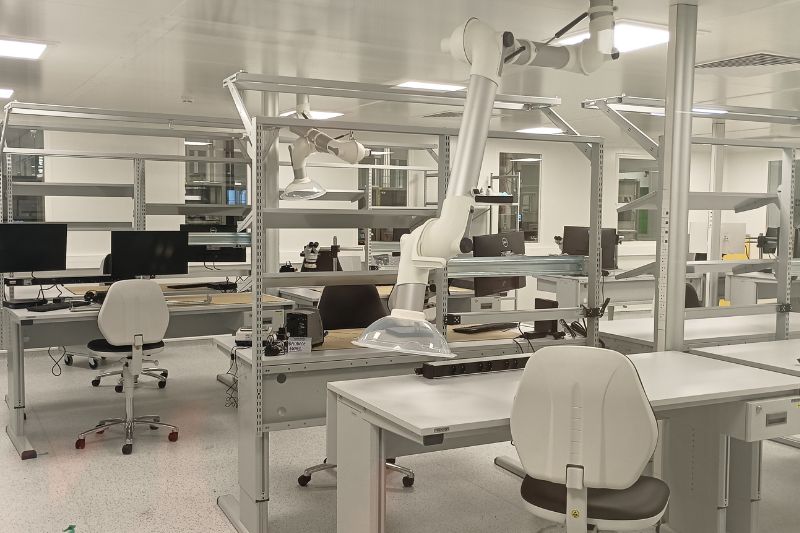
Rakon has officially opened a new ISO Class 8 cleanroom in Pont‑Sainte‑Marie, France.
The company shared with Cleanroom Technology that the facility was constructed by BEMIPHARM, to accelerate the production of its next-generation space subsystems.
The company also said they used a major contractor and local key people for HVAC and electrical work for the cleanroom build.
The ISO Class 8 cleanroom will support the production of resilient space subsystems, meeting NASA and ESA standards within a tight timeframe.
“Customers are looking for assured capacity and clear delivery timelines,” said Chloe Gautrin, Rakon Managing Director, Aerospace and Defence. “This cleanroom allows us to scale production to meet increasing demand at the quality and consistency required for modern space missions.”
Bemipharm, a subsidiary of Beming Group, was established in 2021 in France to develop new buildings or revamp occupied sites for pharmaceutical, healthcare and cosmetics industries.
The facility increases capacity for Rakon’s Space GNSS Receivers and Master Reference Oscillator subsystems, key components for precision timing, navigation and synchronisation in orbit.
Spanning nearly 100 sqm, the cleanroom supports high-reliability manufacturing from incoming material control through final assembly and radiation testing.
The additional cleanroom complements Rakon’s existing Quartz and Ultra Stable Oscillator cleanrooms, reinforcing the company’s capability to deliver mission-critical timing solutions for a broad range of space applications.


