

For pharmaceutical companies targeting cell and gene therapies (CGTs), manufacturing is not the problem. Manufacturing at scale is. Capabilities are lagging behind the biology.
Recently, automated CGT manufacturing company Cellular Origins reached a significant milestone in its work with pharma giant Fresenius Kabi. Manufacturing costs and variability in production approaches are major challenges to the widespread adoption of CGTs, so the two have been working to integrate tech to scale and automate Fresenius’ production.
Beginning back in late 2024, the work aims to integrate Fresenius’ Cue cell processing system with Cellular Origins’ Constellation robotic manufacturing platform. As of now, physical and digital integration of Cue and Constellation has been completed.
The latest studies with human T cells confirm that the Cue system can “reliably” execute complex and precise workflows.
Speaking to VP at Cellular Origins, Jason Jones, about this milestone, he emphasised that the sole aim is not to eradicate human beings from the process, but to “facilitate scale”.
Jones explains that the level of manual intervention required for CGT manufacturing is not realistic for commercial scale. “Reducing”, not eliminating, this workload will make manufacturing more realistic. From a contamination control perspective, removing the humans is only good news. Humans have hair and skin, and they breathe, which is far from ideal for controlled environments. “This is why we need closed systems,” Jones says.
This is why we need closed systems
Closed systems are when the manufacturing is sealed off in a controlled environment from the operators in the cleanroom. Robotics-operated automation of the processes in this closed system is a technological limitation for many. But once it can be done, there are many cost and variability reduction benefits.
For example, a contamination event rate of 0.1% is no big deal at small scale, but becomes a huge real-event occurrence rate when you scale your manufacturing by 100, becoming “untenable”.
In this example, Jones says that you will start to have an event weekly, rather than one or two a year.
With scale magnifying existing contamination challenges, closed systems can be even more appealing. But this is no good if this automation is unreliable. The completion of the first phase of the Cellular Origins-Fresenius collaboration illustrated the level of focus needed to ensure the biological processes are unaffected by automation in these closed systems.
Automating not redeveloping a process
Cellular Origins has already developed a suite of tools that allow the application of automation without changing those biological processes. “We can enable more of a closed fluid pathway, because our robotics can sterile weld plastic consumables together and collect them, without any human operation, and without the mistakes that can happen around that,” Jones explains.
Hidden in this statement is what Jones believes is the key to the Constellation platform. This is not a completely customised new robotic process, but robotic execution of an established one. Meaning the most significant aspect of the Fresenius integration may not be the robotics itself, but the fact that the underlying manufacturing process remains unchanged.
The integration means that the existing Fresenius Cue device can be robotically operated as is. This device is for harvest of the cell product formulation, which will be frozen for transport to the patient. Jones explains that this can now be robotically operated end-to-end, but he adds that, excitingly, the digital system has also been integrated. This means that the process data can be pulled from it and integrated upwards into applications like a manufacturing execution system (MES).
Between the physical and digital automation and streaming, what previously took three people three hours, takes none. Interestingly, the robot being designed to automate existing production processes means it does not just stay at one device the whole time. “It can set [a process step] up, get it running, go off and do another one on another, another Cue device, and so on”.
Cell and gene therapy is a personalised approach to medicine, so unlike other pharmaceutical applications, it is, by nature, a small batch process. Automating workflow steps in this way rather than recreating the process is one of the only ways to create true scale for a unique product every time.
You change your process, the regulatory authority is going to say, ‘Okay, redo your clinical trials’
This has the added benefit of reducing regulatory needs. Developers close to commercialisation in 2026 cannot necessarily afford major revalidation exercises of their processes. “You change your process, the regulatory authority is going to say, ‘Okay, redo your clinical trials’,” Jones explains.
This approach is perfect for companies with approved or late-stage approval therapies.
Why will the Earth benefit?
Jones also reveals that with these closed systems, the teams are now mostly able to operate in a Grade C/D cleanroom. "We’re aiming for Grade C right now," he says. This “downgrading” of the environment’s required control level can reduce the energy and waste requirements. In essence, reducing the facility’s complexity will reduce operating costs.
Removing human workflows creates opportunities for significantly more efficient facility layouts too. Jones reveals that within this collaboration, GMP cleanroom utility increases by 30 to 35%, or in other words, GMP space required reduces by 33 to 35%. Smaller footprints reduce HVAC demand and air handling requirements, as well as facility build costs at the outset.
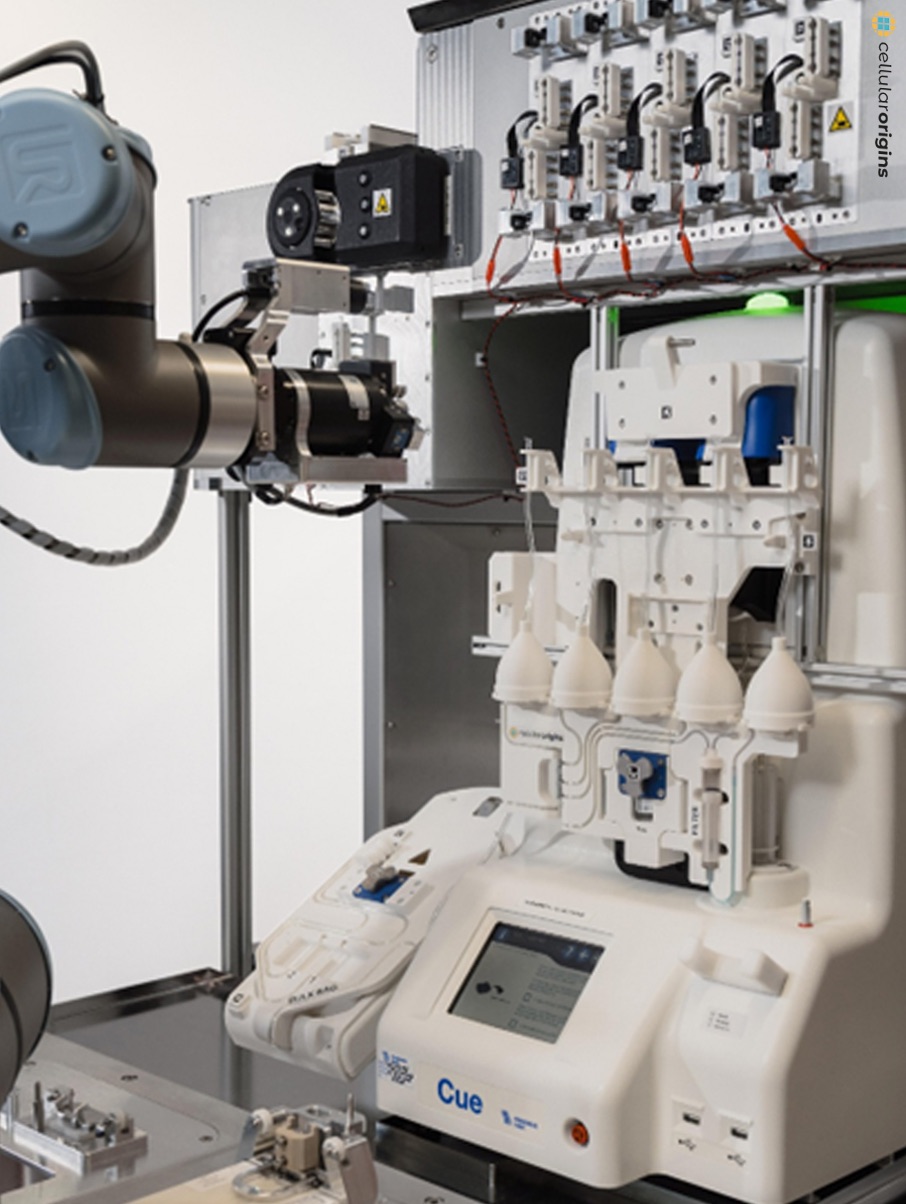
Cellular Origins Cue Technology
Multi-product facilities of the future
Many, including Jones, think that the realistic future of CGT manufacturing at scale will “inevitably” be multi-product manufacturing facilities. He thinks


