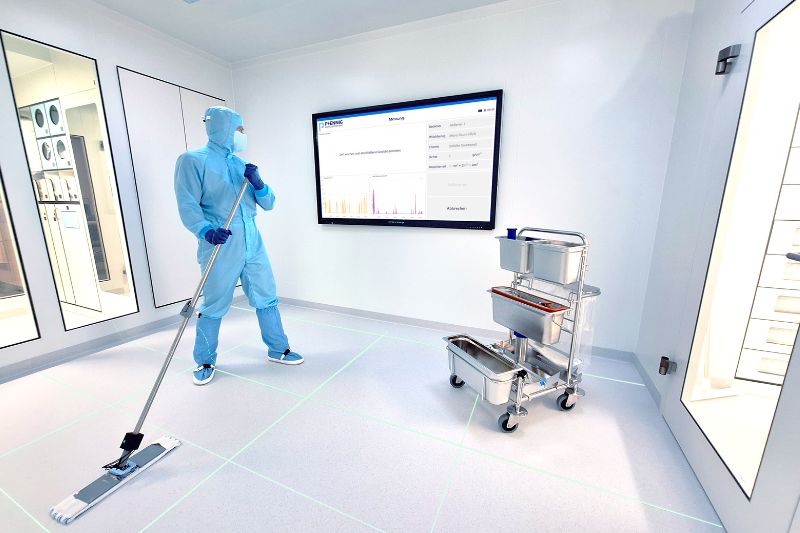

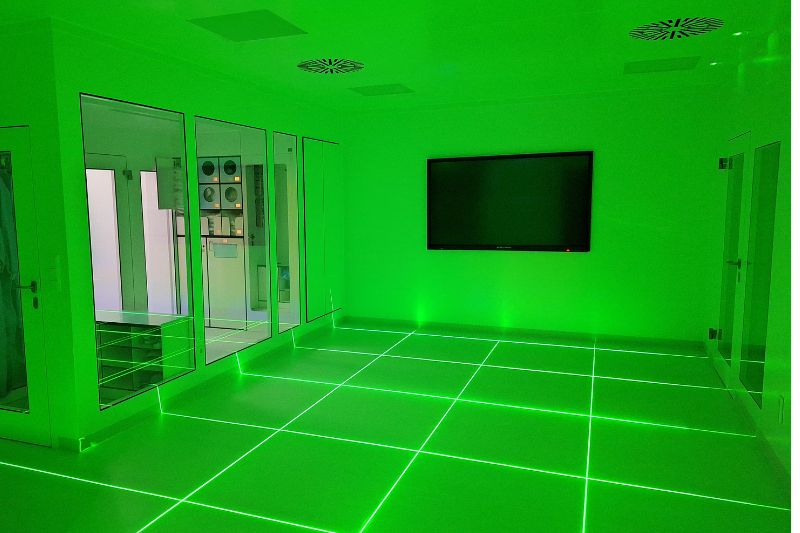
PFENNIG Reinigungstechnik’s latest cleanroom training facility feels almost futuristic.
A grid of laser-lit squares stretches across the floor, projected from modules embedded in the ceiling.
Operators navigate each segment with sensor-equipped mop holders, while AI cameras track motion, and displays show contact pressure, wiping speed, and liquid distribution in real time.
Dimmable lighting highlights how fluids spread across surfaces, creating a dynamic, data-driven training environment that the company calls a “laser holodeck.”
“By integrating ceiling lasers and sensor-equipped mops, we created a controlled environment with real-time feedback that makes technique measurable and reproducible,” Petra Pfennig, COO of PFENNIG Reinigungstechnik, told Cleanroom Technology.
A new approach to cleanroom training
Based in Germany, PFENNIG Reinigungstechnik is a 100% family-owned and oeprated company that specialises in developing and manufacturing high-end cleaning systems, trolleys and microfiber textiles.
The company’s new cleanroom training centre replicates the infrastructure of a real cleanroom, including ventilation systems, personnel and material airlocks, coated walls, stainless steel panels, glass elements, a safety cabinet, flooring, and tables.
Although not ISO-classified, it allows trainees to experience realistic operational conditions while providing precise feedback.
The idea for the centre emerged from PFENNIG's need to modernise its training facilities.
“As part of the upgrade, we integrated a personnel airlock, a material airlock and a safety cabinet to enable more realistic training scenarios. This led to the idea of integrating the laser segmentation directly into the ceiling infrastructure,” said Pfennig. “Since no suitable solutions were available on the market, we developed and implemented the system in-house.”
Previously, floor segmentation relied on manually positioned lasers that disrupted ceiling cleaning simulations.
The new system integrates lasers into the ceiling and sensor-equipped mop system to provide real-time, objective feedback on wiping technique, including pressure, speed, and coverage.
Data-driven cleaning
The facility also addresses challenges in evaluating wiping textiles.
Weight, surface coverage, and liquid absorption are often cited as performance metrics, but comparisons across manufacturers are difficult due to varying test conditions.
The centre allows PFENNIG to measure liquid distribution per square metre, residual moisture, and friction, generating objective and reproducible data.
“By stabilising the wiping process and precisely defining the wiped area, we can analyse liquid release per square metre, evaluate its uniformity and determine residual liquid remaining in the textile,” Kevin Brüstle, Product Development at PFENNIG Reinigungstechnik, told Cleanroom Technology.
Brüstle said that insufficient pressure or overly fast wiping can reduce cleaning effectiveness, even with high-performance microfibre textiles.
Once the wiping process is stabilised, subtle differences in textile construction, such as yarn type or fibre structure, can be measured accurately for the first time.
“Contact pressure and wiping speed are the two most influential variables in real-world cleaning performance,” said Brüstle.
“What surprised us most during early testing and training sessions was the extent to which wiping speed fluctuates, even among experienced operators.”
Brüstle said that it was surprising to find that many professionals unintentionally work faster than recommended, directly affecting surface coverage consistency and reproducibility.
Another important observation Brüstle found was how small differences in textile construction became clearly measurable once the wiping process itself was stabilised.
“Subtle variations in yarn type or fibre structure, which were previously difficult to isolate, became visible in the data under controlled conditions,” said Brüstle.
Training over monitoring
Maximilian Pfennig, Business Development, emphasised that the centre is designed for training and product development, not personnel surveillance.
“The focus is on learning and optimisation, not monitoring individuals,” Pfennig said, noting that the company has prioritised careful data governance in line with workplace privacy standards.
Operators can see how movement, pressure, and technique affect outcomes, while cleanroom managers gain transparency about mop and textile performance.
The laser segmentation makes variability visible, turning best practices from theory into measurable execution.
Turning manual cleaning into measurable science
By combining ceiling-integrated lasers with sensor-based analytics, PFENNIG's facility transforms manual cleaning from a skill-based process into one that is measurable, reproducible, and optimisable.
“Manual cleaning in cleanrooms has long been regarded as a skill-based activity,” said Maxi Pfennig, Business Development at PFENNIG Reinigungstechnik. “Introducing objective feedback does not replace experience, but it makes cause-and-effect relationships visible.”
Pfennig said that as soon as parameters such as contact pressure, wiping speed or liquid distribution per square metre become measurable and visualised in real time, discussions shift from assumptions to data.
This is because operators can immediately see how their technique influences results, while developers can evaluate textiles under controlled, repeatable conditions, closing a long-standing gap in the understanding of manual cleanroom cleaning.
So, what is next for developing the laser holodeck for cleanroom training?
Pfennig said that the answers will reveal themselves as the data develops.
“We have deliberately chosen to let the system mature within our own organisation first. The current focus is clearly on training and product development. In this controlled environment, we can refine the methodology, gain experience and further develop the technology in a responsible way,” said Pfennig.