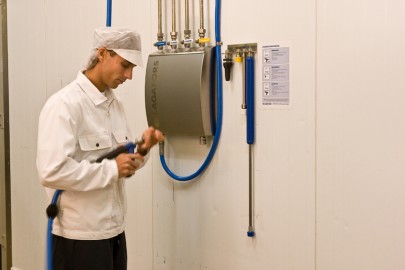
Lagafors, the Swedish manufacturer of cleaning systems and hygiene products for the food industry, has automated the cleaning process for conveyors, with great savings as a result.
The company says the new automatic cleaning system (LAC) not only decreases the use of man-hours and the amount of water, but also reduces chemicals and disinfection usage while at the same time decreasing the bacteriological level on the equipment in production.
The LAC comprises the operator terminal from where all settings are made and two valve stations that regulate the flow of water, chemicals and disinfection. The valve stations are directly connected with the Lagafors chemical centre (VCC) and any of the company’s central pump systems in order to simplify the process and maximise the use of existing equipment.
The operator uses the wall-mounted steering unit to make all desired settings for the cleaning process, inserting the number of conveyors to be cleaned, the cleaning time, which might vary for the different conveyors, and type of cleaning (flush only or total cleaning with water, foam and disinfectants). One steering unit can control up to two different sets of valve stations and each valve station is made up of two stainless steel units. This means up to 30 different conveyors can be cleaned with one operator terminal, depending on the width of the belts.
Lagafors says Swedish slaughterhouse Scan in Uppsala has used the LAC prototype for many years and has seen a 31% reduction in cleaning time and considerably reduced use of water and chemicals.
The LAC comes with standard cleaning programmes but tailor-made versions are available. After a sale, a modem is provided on request, which allows for easy updates of new cleaning programmes or technical developments.