
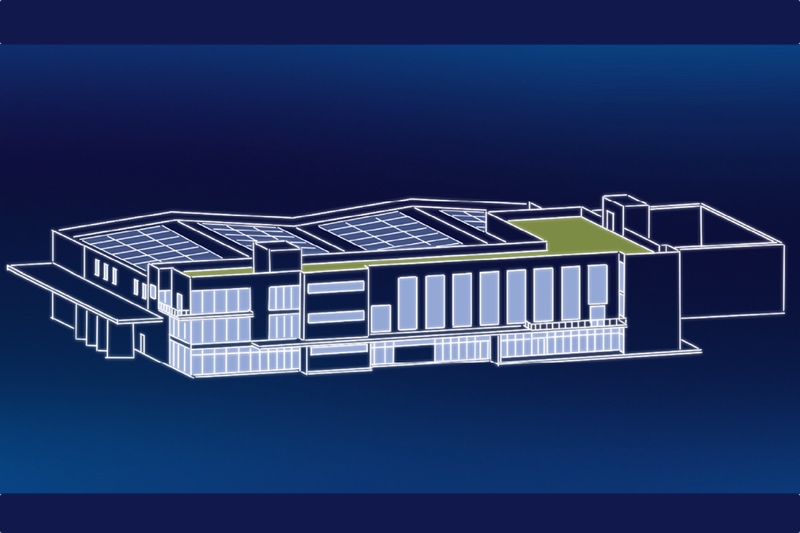
At 2025's Cleanroom Technology Conference, Micronclean turned heads when it announced they were going to be building the world’s first operationally carbon-zero industrial cleanroom laundry in the UK. The teaser invited many follow up questions from the delegates, which the team remained secretive about.
But this month, the Micronclean team has let Cleanroom Technology in on some of the details. Directors, Greg Cochran and Sophie Harris, were keen to share some new technical details and decisions surrounding the company’s £20m investment.
The laundry is just Phase One of the wider 20-acre “campus” plans. The multi-phase development includes the construction of a GMP Grade B cleanroom laundry, new manufacturing facilities for medical devices and cleanroom consumables, a modern warehouse, and a new head office. The Directors say that this will likely see them through the next 5, 10, to 15 years.
With Phase One scheduled to be operational during 2028, Micronclean are keen to share more about the journey, which will set a global benchmark for sustainable operations in cleanroom laundries. When looking at other companies have done by comparison, Cochran says: “We are working beyond technologies that exist in the industry, that our normal supply chains would provide for us.”
This illustrates that the aim is not just to build a best-in-class plant, but to redefine the technical basis of what a modern cleanroom laundry should be.
A fully-electric cleanroom laundry?
To understand the scale of the decision to create a operationally net-zero facility, it is worth considering the baseline. Most cleanroom laundries globally are powered by natural gas. Gas-fired boilers feed steam systems that provide heat for washing, drying, ironing, and even in some cases for aspects of air handling. The typical facility’s carbon footprint is dominated by these combustion processes.
There’s obviously a great deal of emissions that come along with burning natural gas, and as such, Cochran and Harris explain that this has been a major project driver for them. “We have to get rid of gas,” Cochran emphasises.
We have to get rid of gas
Getting rid of gas from the process means electrifying the laundry. Micronclean already uses technologies like solar panels and REGO certified energy (Renewable Energy Guarantees of Origin) in their facilities. “We are now looking at how we can balance our own generation of green energy, as well as then coupling that with our REGO purchasing of electricity from the grid and making sure it's a total sustainable picture,” Cochran says.
What remains to be revealed is exactly how this green energy push will be executed. The Directors are extremely excited but tight-lipped about this, so it will be interesting to keep an eye on this over the project’s duration.
But making this a sustainable facility also requires that the energy demands be brought down. For the cleanroom laundry with all of the hot processes, cooling is a major issue. The team explains that they have a “neat solution” in development to make cooling much more energy efficient.
While precise details remain under wraps on the more proprietary applications, discussion does hint at a shift away from conventional cleanroom HVAC philosophy, and a total re-think of the cleanroom laundry model. Cochran says to keep an eye out for more information that will be released as the months go on.
Another way to reduce energy use in a cleanroom is to look at the environment needs itself. Cochran says that the idea is to push forward technology in plant monitoring to ensure that the plant is being managed effectively and delivering the outcomes we want.
But what about the water?
The other major resource that goes into a cleanroom laundry is water. The process is water-intensive, but this is something that Micronclean have addressed to a certain extent in their Bangalore facility. The India-based facility really pushed the team into innovation of water recycling, since it is a water-scarce area. The facility recycles 90% of its water, but Cochran explains that the team actually want to build on that innovation. Though they don’t know what the “full picture” on this looks like yet, the team is looking at different approaches and technologies to build on this.
Ethical duty can be a win-win
Throughout the interview, sustainability emerged not as a corporate talking point but as a deep-set organisational value. “I’ve never worked anywhere where the company puts sustainability first,” Harris says. “We’re really lucky to have that support.”
She points to the Fry family who run the company, who treat sustainability as non-optional. The two Directors highlight that in 2025, this is not only as an ethical imperative, but as a competitive one. “Businesses will thrive based on sustainability in the next 10, 20, 30 years,” Harris explains. “That’s how businesses will be selected.”
Businesses will thrive based on sustainability in the next 10, 20, 30 years. That’s how businesses will be selected
This cultural foundation helps explain why the new facility is not merely eco-optimised, but fully reengineered for carbon-zero operation from the ground up.
The other social value that the team is bringing to this project is its location. Cleanroom garment processing is a skill-intensive profession. Historically this area doesn't rank very highly on the UK’s most economically advantaged areas. This business remaining here means employment will be secure and increasing, and this is “very, very important” for the area.
The team emphasised the expertise within its existing Skegness workforce, and the importance of retaining that capability. “We’ve been in this area nearly a century, Cochran says. “That’s because of the people we have here, they have the knowledge, the expertise.”
Explore the latest solutions for contamination control, modular cleanroom design, and sustainable cleanroom technologies at the #1 Cleanroom Technology Conference. Click here for more info
A turning point for the industry
Micronclean’s Skegness project is more than a modernisation programme. It represents a technical re-architecture of how cleanroom laundries should be powered, cooled, monitored, and supplied with water.
This new facility aims to embed electrification, proprietary cooling strategies, water recycling, digital optimisation, and facility-level sustainability into the DNA of the design.
Some details remain under wraps, with the Directors careful about what they release at this stage, but the direction of travel is unmistakable. If the facility performs as expected, it could reset expectations for the entire global sector.
Cleanroom laundries may move from gas and steam dependency to an era of fully electric, data-driven, energy-efficient, and water-responsible operations. In short, Micronclean isn’t merely building a new laundry. It is building the first prototype of the cleanroom laundry of the future.