

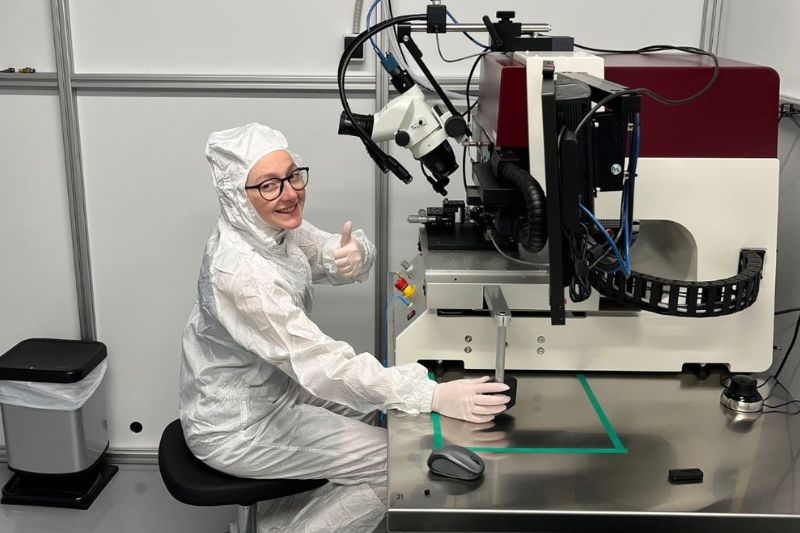
Austrian photonics startup Vitrealab has expanded its cleanroom facilities as it looks to increase production of its laser-LCoS (liquid crystal on silicon) light engines for next-gen augmented reality glasses.
The company said the cleanroom extension was driven by growing demand for its display technology and the need to scale manufacturing as it moves towards wider commercial deployment.
According to Vitrealab, the additional cleanroom capacity will enable it to further miniaturise its light engine technology, improve process stability, increase production throughput and maintain the manufacturing quality required for next-generation AR devices.
The project was led by Daniela Schalmer, who joined the company in March and oversaw the cleanroom expansion.
Vitrealab develops laser-illuminated LCoS light engines designed for lightweight AR glasses, with a focus on reducing the size of display systems while maintaining image quality.
The company recently unveiled its sixth-generation light engine, which incorporates poLight's TWedge wobulation technology.
The technology rapidly shifts the laser beam to reduce laser speckle and other interference artefacts, helping to produce a smoother, clearer image for wearable AR applications.
The company said that the market for compact AR display technologies continues to grow, with many manufacturers seeking smaller, higher-performance optical engines capable of supporting consumer-grade smart glasses.
Vitrealab's manufacturing investment is intended to strengthen its ability to meet this demand while scaling production of its proprietary laser-LCoS technology.


