
Over the last four years, Staubli has been steadily working with a Big Pharma company to put robots in cleanrooms.
The mechatronics expert has been working on their Sterimove concept since 2022, and with recent regulatory changes upping the pressure on cleanrooms, there has been an increasing demand for automation just like it.
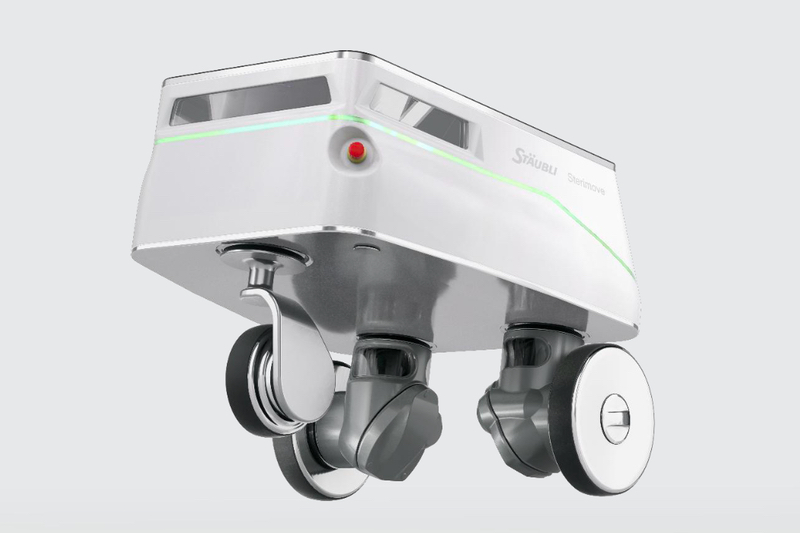
In basic terms, Sterimove is a mobile robot designed to operate safely inside pharmaceutical cleanrooms. It can move materials or equipment while meeting strict hygiene standards. The idea behind Sterimove is that different modules can be added to the top to customise the function.
Julien Lora is the Marketing Lead for AGV at Staubli and has been key to Sterimove’s development journey. Lora explained that rather than incremental improvements in existing tech, the aim was to introduce a new category of automation. This new solution would open “a bunch of opportunities for applications in cleanrooms”.
After initial concept validation, the system moved through several years of prototyping and refinement, incorporating feedback from across the pharmaceutical sector. It was then first publicly showcased at industry events in 2024 to gauge wider market interest, before making a more formal debut at events such as INTERPHEX in 2025.
The latest iteration, presented in 2026, reflects ongoing refinements to the design and Lora says positions Sterimove as a near-market-ready solution shaped by real-world cleanroom requirements.
But what is actually important in launching a robot for pharmaceutical manufacturing in a cleanroom? Speaking to Lora, the foundations are clearly cleanability, safety, modularity and a solid customer integration network.
What is “cleanability” in robotics?
Lora reveals that the fundamental concept behind Sterimove’s modularity emerged from a four-day brainstorming session between the Staubli robotics team and their pharmaceutical collaborators. This session focused on user-led design, and by the end of it, there was a highly focused brief on what they wanted to create.
Aiming to be used in up to Grade A conditions, the principles decided at this session put a heavy emphasis on making the robot easy to clean, or its “cleanability”. For this, the team made sure to turn to the European Hygienic Engineering Design Group (EHEDG). This group provides guidelines for ensuring hygienic design, such as reducing retention areas. Even the wheels were designed to reduce retention and aid ease of cleaning.
Lora explains that in line with EHEDG, the team were intent on making every single square centimetre cleanable by hand. To do this, they made all gaps a minimum of 23.5mm. When the original prototype was built to test this, there were some minor areas that were too small for a finger and required grooves to be added to the design.
The team were intent on making every single square centimetre cleanable by hand
Push buttons were also raised as a place where cleanability was challenged. As Lora explains, these are retention areas for contamination, so every single one was replaced with magnetic buttons. Even the charging of the robot is performed through induction, to remove the need for a charging port which would create a retention point.
Materials were also considered for cleanability, and in a world where VHP is a popular decontamination choice, these had to be resistant to it. So this factor was also made a key point of the robot’s design.
With contamination control being one of the strongest cases for a move from humans to robots in pharmaceutical manufacturing, the cleanability of any cleanroom robot is a make-or-break design factor.
Working with robots?
Lora also calls the new robot “collaborative”, meaning it is able and designed to work among people.
Traditionally, robots are separated by barriers, such as in a lot of modern-day isolators and RABs. This is perfect for contamination control, but raises some practicality and flexibility issues. But the Staubli solution works in the same space with human operators, which comes with its own challenges. Safety key among them.
Lora explains that the Sterimove is led by ISO 3691-4, which is a very well-known standard in the mobile robotics industry, as it sets the requirements of automated guided vehicles. Sticking to ISO 3691-4 means the Staubli robot should be able to work collaboratively with humans without risk to their safety.
To do this, the robot uses laser-based navigation and real-time environment mapping. Specifically, the team has put a brand new concept on the market. “We are using… a brand new innovative concept for the safety… through two 3D laser scanners,” Lora explains. He calls this the “gold standard” of robotics navigation.
What does modularity in a cleanroom robot mean?
A key feature of Sterimove is its modularity, allowing users to adapt the robot to different cleanroom tasks. Essentially, the system has a base unit that can then have multiple applications placed on top. This could be a robotic arm for performing process tasks, a transport unit for moving products from room to room, or another relevant tool.
From a contamination control task perspective, Lora explains that you can attached solutions for environmental monitoring of air and surfaces, or even perform isolator glove checks overnight to save operational time during the day.
Lora says that this modularity had previously not been possible for safety or cleanability reasons. With this in mind, he think this robot opens up new possibilities, particularly in environments where fixed automation has traditionally limited flexibility. As Julien Lora puts it, the system enables users to rethink processes and develop new use cases. In essence, Sterimove isn’t just a one-use robot; it’s a configurable platform that evolves with operational needs.
What is Sterimove’s unique offering?
One of Staubli’s strongest differentiators is its long-standing presence in pharmaceutical robotics. Rather than entering cleanroom automation as a newcomer, the company is building on more than two decades of experience with robotic arms in isolators.
30 years of expertise is not just a benefit by itself; it also means an established network within the pharmaceutical sector. Over years of supplying robotic systems to cleanroom environments, the company has built relationships with major pharma manufacturers, and this will most likely play a critical role in Sterimove’s ongoing rollout.
Rather than entering cleanroom automation as a newcomer, the company is building on more than two decades of experience with robotic arms in isolators
Lora then talks about another benefit of the company’s established position. He explains that this new robot will come with an established network of system integrators.
These system integrators are specialists who go to the client’s environment and ensure robots are installed and validated correctly within highly regulated environments. As Lora explains, these partners are “instrumental” in taking a product off the shelf and integrating it safely and compliantly into a facility.
Another key advantage is the use of digital twins. Before any physical installation, Sterimove can be simulated within a virtual model of the cleanroom to test layout constraints and workflows. “Everything you can do, you can do in digital twins,” says Lora, including checking corridor widths, system connectivity, and interactions with infrastructure such as automated doors. This virtual commissioning approach can reduce risk and shorten deployment time.
Lora makes it clear that not only does your product have to be solid for a successful rollout, but with a product as complex as robotics, you need to think about actual use support in the short and long term.
Robots taking jobs in pharma?
As with many automation technologies, the introduction of mobile robots raises concerns among operators. Lora acknowledges that fear directly: “[Operators] fear that this mobile robot is going to steal their job.”
In some cases, he notes, this can even lead to resistance during implementation. For this reason, Staubli emphasises early engagement with operators, ensuring they are involved from the beginning and understand the robot as a support tool rather than a replacement.
At the same time, the contamination control argument for automation is becoming harder to ignore. “The main source of contamination in a cleanroom is a human being,” Lora points out. With the update of EU GMP Annex 1 in 2023, choosing automated and robotic solutions is no longer going against the grain, but is explicitly encouraged.
The document, which, although EU-based, is used worldwide as a benchmark, gives the standards for the production of sterile medicinal products. The update from 2023 is now strongly based on Quality Risk Management (QRM) and Contamination Control Strategy (CCS) principles, and manufacturers are effectively encouraged to ask: “Can automation/robotics reduce risk better than manual operations?”
In practice, this pushes adoption of robotics wherever feasible, but while the potential is clear, widespread adoption will take time. As Lora puts it, “This is the beginning of the story.” He compares the current moment to the early stages of the technology acceptance curve, where awareness is growing but the market is still learning what is possible.

With increasing regulatory pressure and a clear need to reduce human intervention, solutions like Sterimove may soon move from early adoption into the mainstream, reshaping how cleanroom operations are designed and run.
While fully “lights-out” cleanrooms may still be some way off, more and more technologies like Sterimove are appearing on the market, and represent a real step towards reducing human intervention in pharmaceutical manufacturing.