
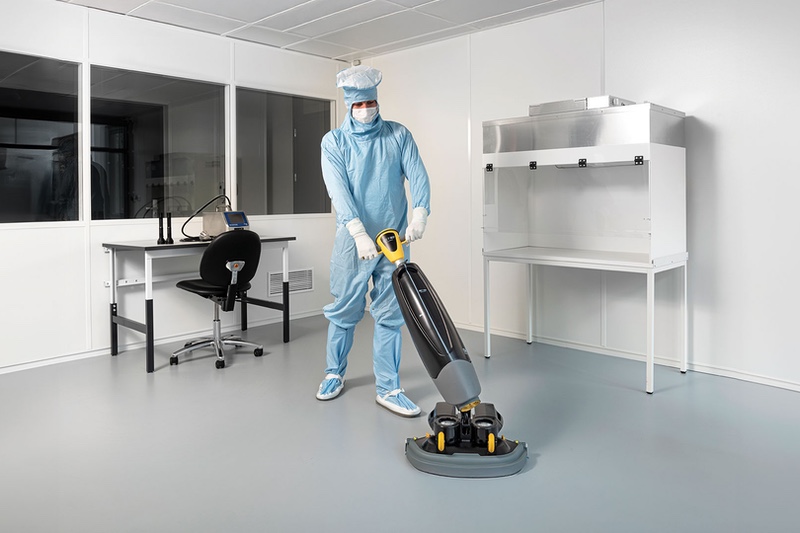
Maintaining the highest standards of cleanliness in cleanrooms is crucial for industries ranging from pharmaceuticals to food production and semiconductor manufacturing. The challenges involved are far more complex than following protocols, as even the smallest contamination can compromise product integrity. Strict regulations, pathogen risks, continuous monitoring, minimising human error, staff shortages, and reducing downtime are some of the ongoing challenges.
So how can organisations optimise their cleaning strategies while ensuring compliance? Technology, covering everything from data-driven cleaning to smart ergonomic equipment, is redefining safe and efficient operations.
Reducing downtime and operational costs
When contamination issues occur, production temporarily comes to a halt, which can cost tens of thousands of pounds for a large, complex cleanroom. This is one of the biggest challenges and a key reason to opt for more efficient cleaning solutions. By using efficient cleaning methods and mechanical solutions, production can restart faster, saving significant overhead.
Cleaning teams play a vital role in minimising downtime, following strict protocols. Integrating advanced training programmes, such as virtual reality (VR) simulations, helps employees to practice correct cleaning techniques in a controlled environment. Additionally, smart ergonomic tools with built-in guidance systems help reduce user error. In some high-tech cleanrooms, automated systems provide real-time feedback on cleaning performance, ensuring that no critical areas are overlooked.
Proactively navigate protocols
Airborne particle contamination is a challenge for every cleanroom. ISO 14644, the cornerstone of cleanroom standards, specifies the classification of air cleanliness in terms of concentration of airborne particles.
Each ISO classification allows a certain maximum number of particles per cubic metre of air. This, along with additional protocols, including Good Manufacturing Practice (GMP), ensures that contamination control, stringent cleaning processes, and verification procedures are adhered to. However, compliance is more complex and goes beyond following these cleanroom standards. Organisations should adopt a proactive approach by implementing real-time monitoring systems and standardised cleaning processes. Emerging trends, such as automated validation and digital documentation, help facilities stay ahead of evolving regulations. For example,


