
By Kevin Hackett, Sr. Project Manager, Performance Contracting Inc. (PCI)
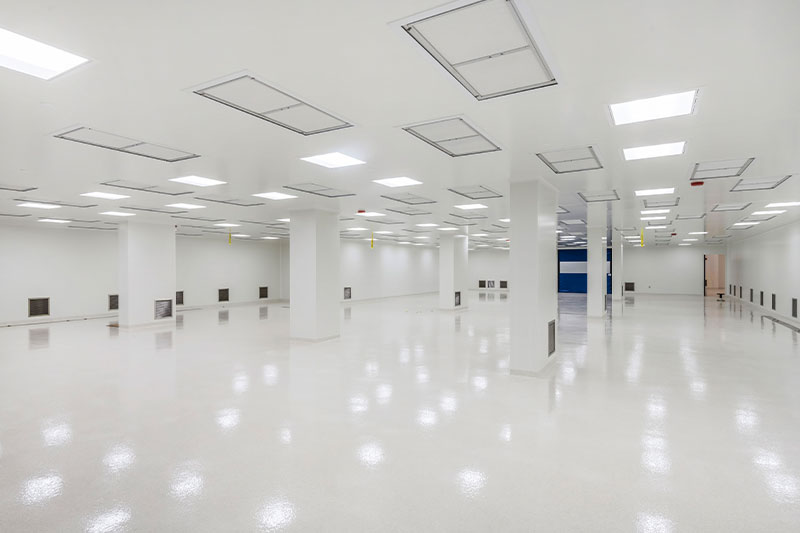
As cleanroom facilities evolve toward higher classifications and more aggressive delivery schedules, the ceiling-down philosophy has moved from a best practice to a mechanical necessity.
Sector-Specific Engineering Constraints
While ISO 14644 standards provide the baseline for particle control, the structural and functionality requirements of the ceiling vary drastically by sector.
- Pharmaceutical, Biotechnology and Life Sciences: The priority is cleanability and airtight integrity inside the cleanroom while providing a structurally sound mechanical platform for end user MEP serviceability above the ceiling. This requires systems with minimal joints and strong resistance to aggressive sporadical agents such as vaporised hydrogen peroxide (VHP).
- Semiconductor and Microelectronics: In these environments, the ceiling must mitigate vibration, manage high-volume laminar airflow, and support sophisticated automated material handling systems. Here, the grid is often an active participant in ESD (Electrostatic Discharge) protection.
In both sectors, the ceiling acts as the anchor point. Head of wall tracks are fixed to the underside of the ceiling system, and MEP fixtures are staged around its structural framework. When the ceiling is accurately engineered and coordinated early in the design process, it establishes a strong foundation that minimizes field clashes; when overlooked, it often becomes the primary source of conflicts in the field due to the number of different systems and scopes that converge within the ceiling.
Structural Capacity and Life Safety
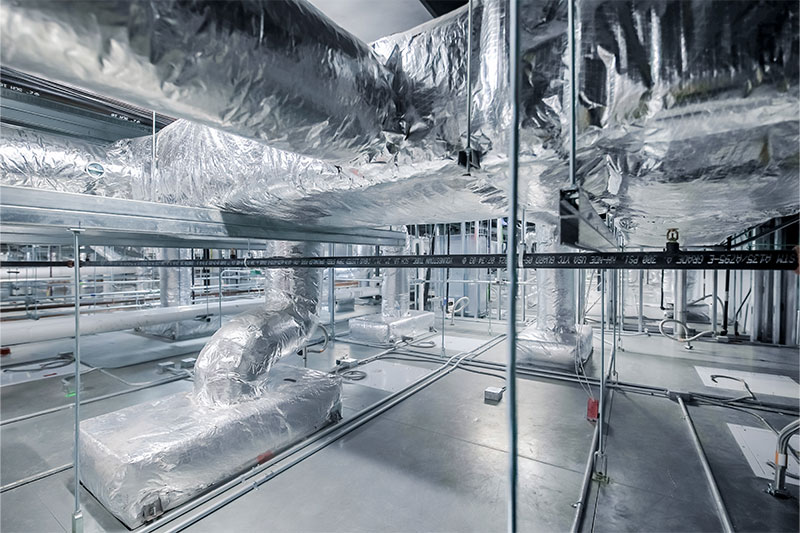
Walkable ceiling systems are increasingly standard for modern facilities, but they introduce significant engineering liability. From the structural members that form the building’s primary framework, to the secondary support framing and threaded rods supporting the ceiling system, and ultimately to the panel construction itself, each component plays a critical role in defining the loading criteria of a walkable ceiling.
These elements must be carefully coordinated and designed in accordance with how the end user intends to access and utilise the ceiling system, while also complying with applicable building codes, including seismic requirements that influence support spacing, bracing, and overall system performance.
In high-traffic interstitial zones, standard honeycomb panels may face delamination over time. To counter this, we have moved toward reinforcing critical pathways with a diamond-plate or strong composite material to provide added rigidity to those panels.
Specific to modular ceiling panel systems, strict penetration tolerances must be maintained to avoid compromising the structural integrity of the panels. Where a high concentration of MEP fixtures within a single panel results in significant material removal, supplemental midspan threaded rod supports can be added to increase load capacity. However, the addition of these supports increases congestion within the interstitial space and must be carefully coordinated and clash-detected against other building systems during preconstruction to prevent conflicts in the field. We recently managed a project where 526 distinct ceiling clashes were identified and resolved in the digital twin, saving weeks of potential field delays.
To combat lateral movement for a recent project in a high-seismic zone, we engineered a brace-and-strap configuration that utilised wall panels as lateral supports. This transformed the walls and ceiling into a unified structural diaphragm, capable of maintaining integrity under both seismic stress and high air-change rates.
The Level Plane: Managing Substrate Variability
One of the most persistent challenges in installation is establishing a perfectly level plane. On large slab-on-grade projects, even minor concrete variations can ripple upward.
The best technical practice is the implementation of a comprehensive pre-installation survey. Identifying high and low points in the floor slab enables proactive adjustment of project benchmarks, allowing the ceiling to be set at an elevation that minimises variation in designed ceiling heights from room to room while remaining within the allowable tolerances of wall floor track adjustability.
Maintaining ceiling levelness is an ongoing, project-long effort, particularly in new construction. The use of turnbuckles at the threaded rod-to-ceiling connection allows for precise and efficient adjustments, which is critical as the building undergoes settlement, experiences climate-related expansion and contraction, and as roof and structural members are loaded and deflect over time. Without periodic re-adjustment to original benchmarks, these factors can lead to unintended deviations in ceiling elevations.
Innovation in Integration
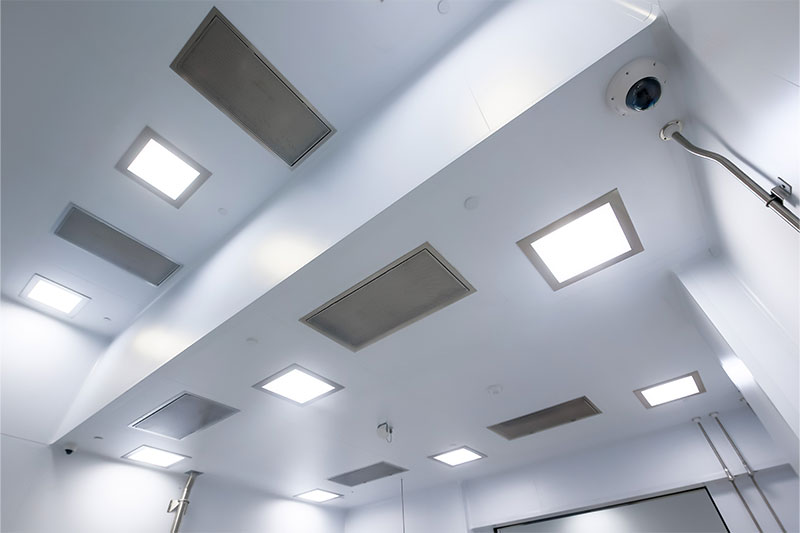
Current innovations are focused on reducing on-site labor and schedule congestion. The use of CNC machines to pre-cut ceiling panels for fixtures significantly decreases installation time while eliminating the safety risks associated with field cutting. With adequate planning, this approach also enables the pre-integration of lighting fixtures into the panels prior to delivery.
Additionally, by utilising embedded raceways within the panels, lighting can be pre-wired and stubbed out at designated connection points, such as the corner of the panels near threaded rod locations, allowing for quick and efficient field connections. This not only streamlines installation but also minimises the need for surface-mounted conduit, reducing congestion and mitigating trip hazards within an already crowded interstitial space.
In the modern cleanroom, the ceiling is the foundation of the build strategy. It is the plane that sets the build, the structure that carries the utility load, and the barrier that ensures environmental compliance. By engaging in ceiling-down design early in the pre-construction phase, owners and AEC partners can ensure that the most critical part of the facility is also the most reliable.