

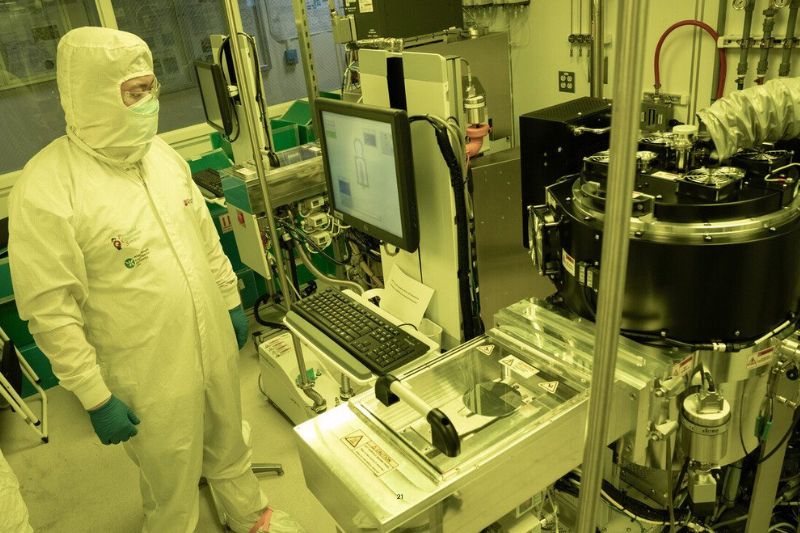
Virginia Tech has secured a $20m grant from the US National Science Foundation to establish an artificial intelligence-enabled, cloud-based semiconductor laboratory.
The Virginia Tech Programmable Cloud Laboratory (PCL) Node will combine semiconductor manufacturing equipment with AI-guided workflows, automation and cloud technologies, allowing researchers to conduct experiments remotely.
The project is part of a wider network of AI-enabled autonomous laboratories being developed through the US Department of Energy’s Genesis Mission.
The multidisciplinary project team is led by Qingyang (Rose) Hu, Head of Virginia Tech’s Bradley Department of Electrical and Computer Engineering, and includes researchers overseeing the university’s semiconductor cleanroom and nanoscale fabrication facilities.
Semiconductor cleanroom
The PCL Node will make use of Virginia Tech’s existing Micro-/Nanofabrication Cleanroom and Laboratory, also known as the Micron Technology Semiconductor Processing Lab.
The facility supports semiconductor and microfabrication research and includes equipment for processes such as photolithography, thin-film deposition, etching, wafer bonding and thermal processing.
The cleanroom supports thin-film deposition and etching, including atomic layer deposition, sputtering and deep reactive ion etching.
Its wider nanoscale facilities include a 200kV electron-beam lithography system capable of resolutions down to 2nm.
The new cloud laboratory will connect these fabrication and characterisation capabilities with AI-guided workflows, enabling researchers to remotely design, run and analyse semiconductor experiments.
Virginia Tech is collaborating with other academic institutions, Oak Ridge National Laboratory, the National Institute of Standards and Technology, and industry partners including NVIDIA and Amazon Web Services.
The university is one of 20 NSF-funded teams developing nodes for the wider autonomous laboratory network.


