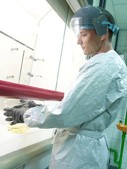
Partial protection is useful when an increased barrier effect is required to protect certain parts of the body against a higher risk for a limited period. For example, a Type 4 chemical protective suit made from Tyvek can be combined with Tychem accessories to protect against liquid chemicals in addition to providing particle protection in these areas or where a coverall generates too much heat stress. Combining accessories can also be economical since they can be used to replace worn out areas without having to replace the entire protective clothing. Tychem C provides a barrier against many concentrated inorganic chemicals, while Tychem F provides an additional barrier against many organic and highly concentrated inorganic chemicals, up to pressures as high as 5 bar. Both materials satisfy the requirements of a bio-barrier in accordance with EN 14126 in the highest performance class. Tychem is ultra light, tear-resistant, abrasion-resistant and low-linting. When used in protective apparel, it is anti-statically treated and complies with EN 1149-1:1995 (fully effective from 25% relative air humidity). In addition, the protective apparel can be safely and easily disposed of after use. If contaminated by a hazardous substance, the same disposal regulations apply as for the hazardous substance. www.dpp-europe.com
DuPont offers personal protection with Tychem accessories
DuPont is expanding its range of protective apparel in Europe with partial protection accessories made from Tychem, which are suitable for laboratories, the chemical and pharmaceutical industries, paint shops and some cleanroom environments. Available in both Tychem C and Tychem F, they include close-fitting sleeves, standard aprons, sleeved aprons with back fastening and boot covers with slip-retardant soles.