
The cleanroom is one of the most carefully controlled environments in life sciences manufacturing. It is designed, built, qualified, monitored, cleaned, maintained, and operated against detailed expectations. It also represents a significant investment of time, expertise, and resources.
Yet in many organisations, much of that investment is still treated as if its main value is achieved when the qualification report is approved and filed.
Day-to-day management of the cleanroom’s qualified state often depends on paper records, electronic documents, spreadsheets, emails, logbooks, and experienced people who know where to look and who to ask. These tools can work, but they rarely give operators, quality teams, engineering, and operations leaders an immediate view of the current state of the cleanroom.
Digital qualification changes this paradigm. When qualification records, monitoring data, maintenance schedules, cleaning records, and operational activities are connected, the qualified state becomes a live source of operational information. The data and framework created during qualification continue to support the room throughout its operating life.
A digitally enabled shift start
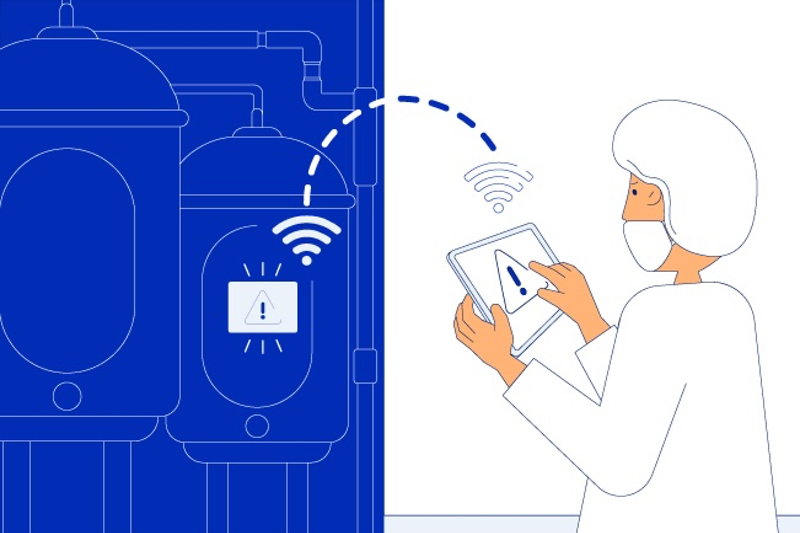
An operator completes gowning, enters the cleanroom, and signs into a workstation or tablet. Instead of relying on a batch record, several logbooks, a whiteboard update, and verbal handover notes, the operator sees a current view of the suite.
That view includes tasks due today, notifications raised since the last login, relevant maintenance activities, open or recently closed quality events, environmental monitoring status, cleaning status, and the qualification status of linked systems and utilities.
The operator starts with the current state of the room already visible.
That only happens when the cleanroom qualification and validation programme has been executed and maintained digitally, with qualified systems, controlled parameters, maintenance schedules, environmental monitoring activities, and operational records captured as structured, connected data.
The qualified state can be maintained continuously rather than confirmed periodically and filed
Environmental monitoring: Early warning with context
An overnight settle plate shows early signs of microbial growth. In a traditional operating model, that result may sit within a laboratory information management system until QC review. Operations may not become aware of the concern until manufacturing has already started. By then, the site may be dealing with an avoidable deviation, product impact assessment, or a difficult decision about in-process material.
In a connected digital environment, the early warning is surfaced to the operator and the relevant quality and operations teams before the next activity proceeds. The team can immediately review the recent operational history of the room.
They can see whether a full room clean was completed after the settle plate was placed, who performed it, when it was completed, which cleaning agents or biocides were used, and whether the activity was reviewed and signed off.
They can look further back to a line clearance that took place in the previous 48 hours, involving multiple personnel, equipment changeovers, removal of single-use components, and introduction of new materials from warehouse storage. That context helps the team understand whether the result may be linked to a recent high-activity event, rather than treating it as an isolated laboratory finding.
The system gives the team the information needed to decide actions quickly and proportionately. Where action is required, perhaps an additional wipe-down of equipment introduced during the changeover, that action can be assigned, tracked, completed, and closed in the same digital environment.
Early warning becomes useful because it comes with the information needed to act.
Qualified utilities should be visible to operations
A HEPA filter change may be routine maintenance, but it can temporarily affect the cleanroom’s qualified state. Depending on the room, operation, and site procedure, there may be a defined recovery period, clearance requirement, or requalification step before the area is returned to use.
In many facilities, the maintenance schedule sits with Engineering or Facilities. The production schedule sits with Operations. The connection between the two may depend on planning meetings, emails, or someone remembering that the maintenance activity could affect a manufacturing window.
In a digitally qualified environment, maintenance activities for utilities linked to the cleanroom form part of the operational status of that room.
An operations manager planning a multi-day chromatography column unpacking and repacking activity can see that HEPA filter replacement is scheduled during the same period. That matters because the process may involve an open column and resin exposed to the cleanroom environment for an extended time.
Operations and Maintenance can then align on when the filter change will occur, how long the room will be unavailable, what checks are needed afterward, and whether the column operation should be rescheduled, resequenced, or protected through additional controls. The room is used with awareness of its qualified state, rather than discovering too late that routine utility maintenance has created a manufacturing conflict.
Handovers should focus on decisions
Shift handovers are essential, but they are also expensive. Skilled time is often spent repeating information that should already be visible: what was completed, what was cleaned, what remains open, what is scheduled next, and whether any issues were observed.
If completed activities and open actions are already available to the incoming team, handover can focus on the items that require discussion.
Managers spend less time reciting the previous shift and more time addressing exceptions, priorities, constraints, and decisions. Operators start work with a clear view of what happened and what needs to happen next.
Shift handovers are essential, but they are also expensive
Across multiple shifts, suites, and sites, this reduces manual information transfer and increases time spent executing, reviewing, improving, and controlling the process.
Risk-based decisions need timely information
A water sample should be collected from a controlled water drop in a manufacturing suite. The sample has not failed. It has simply not yet been taken, or the result is not yet available. An operator preparing to initiate buffer preparation receives a notification that the qualified status of the suite may be affected by the outstanding activity.
In a paper-based or disconnected environment, this may not be visible until much later. The operator may proceed without knowing there is an open sampling requirement. The issue may only be found during retrospective review.
In a connected environment, the issue is raised before the operation begins.
Quality and operations can immediately review the history of that sampling point. They can see whether previous results have been consistently within trend, whether there are related deviations, whether other samples from the same system are acceptable, and whether the risk relates to a late sample or an actual adverse result.
They may decide that work should not proceed. They may decide that work can proceed with documented justification. The important point is that the decision is made knowingly, based on available evidence, and recorded in the system without reliance on informal conversations, retrospective explanations, or individual memory.
Building data is more useful when connected to room activity
Cleanrooms are controlled through multiple systems, including the building management system. Temperature, humidity, pressure, and air handling data may be available, but often not in the same environment where manufacturing activity is planned, executed, and reviewed.
This separation matters during investigations.
A temperature excursion occurred during a shift. The first step is often to ask Facilities to pull the BMS trend. Manufacturing records are reviewed separately. The team then reconstructs what happened across different systems and timelines.
In a digitally connected environment, Operations, QA, and engineering begin with a shared view.
They can see the temperature trend and the manufacturing activities taking place at the same time. The team can assess whether high-temperature operations could reasonably explain the excursion.
If those activities are routine and should not have caused the room to move outside its qualified range, the investigation can narrow quickly. The issue may be related to a sensor fault, a ventilation control issue, or an underperforming cooling system.
The investigation improves because environmental data and operational context are reviewed together.
Digital qualification depends on connected data
These capabilities depend on an important prerequisite: qualification itself must be executed and maintained digitally.
If HVAC qualification records, environmental monitoring schedules, calibration records, cleaning activities, utility maintenance plans, requalification requirements, deviation histories, and manufacturing records remain isolated across departments and document repositories, the organisation will still spend time pulling information together whenever a decision is needed.
A digitally qualified environment requires these records to be connected. Not necessarily all in one system, but connected in a way that allows the operational status of the room to be understood in context.
The system will know which utilities support the room, which maintenance activities affect availability, which samples are required, which results are pending, which cleaning activities were completed, which equipment was introduced, and which operations were performed.
The qualified state is maintained continuously rather than confirmed periodically and filed.
The real value comes after qualification
The life sciences industry already understands the importance of cleanroom qualification. Regulatory expectation is well established, and the technical discipline remains essential.
The larger opportunity is what happens after qualification is complete.When the qualified state of the cleanroom is available as a live operational record, it supports daily decisions. Operators begin each shift with better awareness. Maintenance activities are considered before they interfere with manufacturing. Environmental monitoring signals are assessed with context. Utility concerns are evaluated before production. Handovers become more focused. Quality decisions are evidence-based.
Experienced people remain central to the process. They are simply given better information earlier.
A digitally qualified cleanroom becomes an operational asset that helps the site plan better, respond faster, and maintain confidence in the controlled state of the manufacturing environment.
That is the practical value of digital qualification: manufacturing made more controlled, more transparent, and more resilient shift by shift, decision by decision, and campaign by campaign.


