

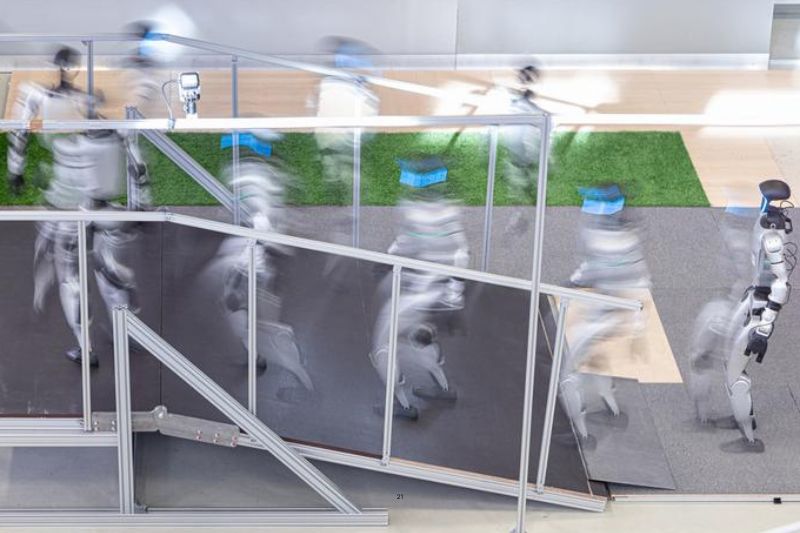
The Fraunhofer Institute for Manufacturing Engineering and Automation (Fraunhofer IPA) has launched a standardised benchmarking service designed to provide independent assessments of humanoid robots for industrial applications, including cleanroom manufacturing environments.
The new service will enable manufacturers and end users to independently evaluate humanoid robots against six application-relevant criteria.
These six criteria are: technologies and basic capabilities, complex capabilities, cleanroom suitability, functional safety, cybersecurity, and energy efficiency.
“Users can interpret the results directly and thus find the right humanoid for the right application,” said Werner Kraus, Head of Research Division Automation and Robotics at Fraunhofer IPA.
The benchmark allows manufacturers, end users and software providers to measure performance, operational suitability and safety using internationally recognised standards.
Fraunhofer IPA said the initiative addresses growing demand for objective performance data in a rapidly evolving humanoid robotics market, where marketing claims often outpace independently verified capabilities.
These factors are intended to support deployment decisions in industries including semiconductor manufacturing, pharmaceuticals and food production, where contamination control is critical.
The benchmark was developed with funding from the Baden-Württemberg Ministry of Economic Affairs, Labour and Tourism through the AI Innovation Center "Learning Systems and Cognitive Robotics".
What was evaluated and what were the findings?
For cleanroom environments, the assessment measures particle emissions in accordance with ISO 14644-14, alongside outgassing behaviour and cleanability.
The functional safety module evaluates robot stability, collision forces, obstacle detection and system behaviour during failures, while cybersecurity testing covers vulnerability management, secure lifecycle processes, network security and resistance to penetration attacks.
Energy efficiency testing measures battery life and power consumption across different operating scenarios, including standing, walking and carrying loads.
Energy efficiency testing recorded a maximum operating time of two hours and 49 minutes while standing and one hour and 49 minutes during a representative operating scenario combining standing and walking.
First use case
Fraunhofer IPA has already completed the first comprehensive assessment using the Unitree G1 EDU-4 humanoid robot equipped with three-finger hands.
The evaluation found that the robot demonstrated effective self-stabilisation and could potentially be suitable for ISO Class 5 cleanrooms.
However, testing also identified limitations, including collision forces exceeding 500N, well above pain thresholds defined by current collaborative robot safety standards, and a Bluetooth security vulnerability that could have allowed unauthorised remote access.
Fraunhofer IPA said the software vulnerability has since been addressed.
According to Kraus, the benchmark is intended to help companies compare humanoid robots both with one another and with established automation technologies.
The evaluation was launched to support more informed investment decisions as automation expands into tasks traditionally carried out manually.
Fraunhofer IPA plans to extend the programme by evaluating additional humanoid robots and establishing a comparative database.
The institute is now offering individual benchmark modules as well as full evaluations to manufacturers and end users seeking independent validation of robot performance across industrial applications.


