

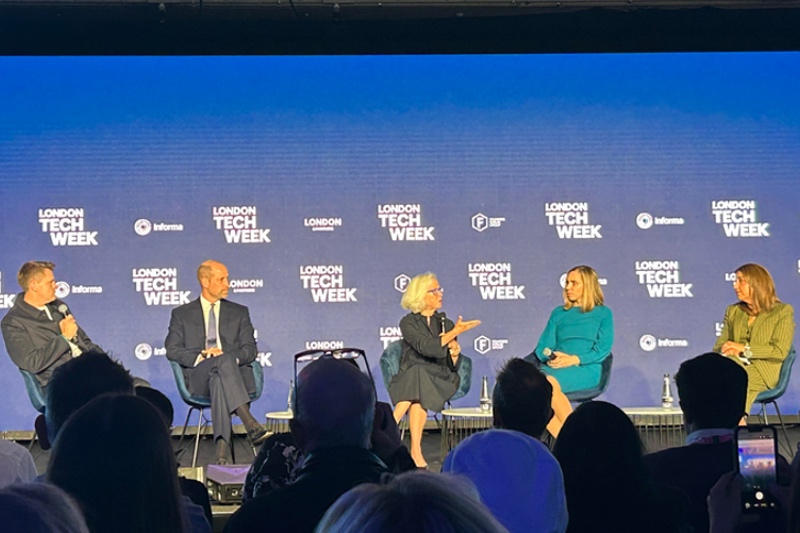
London Tech Week 2026 is a three-day event with fringe activities that gives attendees a platform to discuss and advance technological developments of the last year.
As of 2014, this annual event has fostered partnerships between startups, scaling enterprises, and multinational giants.
On early days, talks focused on technology in aerospace engineering, as well as quantum engineering. In later days, talks were then given by a huge variety of speakers, from Prince William, to Shobie Ramakrishnan, Chief Digital & Technology Officer at GSK.
Technologies such as AI are reshaping pharmaceutical discovery and development pipelines. Heading these efforts up for GSK, Ramakrishnant explains that the company’s highest priority is its ability to accelerate and improve these pipelines. This is where the cost savings lie. AI is changing how drug targets are identified and selected for further investigation, enabling researchers to analyse vast datasets, including genomics data that were previously difficult to process at scale.
Ramakrishnan also highlighted AI’s role beyond discovery. She said that there are other avenues, such as improving vaccine yields and helping extract greater productivity from existing manufacturing assets.
The executive also emphasised the responsibility of those who operate in the pharmaceutical sector. She reinforced that managing AI and sensitive data brings significant responsibility, requiring strong accountability, governance and regulatory oversight.
If you work with cleanroom systems or controlled environments, the Cleanroom Technology Conference offers technical presentations and interactive sessions to deepen expertise and stay ahead in the sector.
Beyond pharmaceuticals, AI is also making waves in industrial engineering by speeding up the simulation and optimisation processes that underpin modern manufacturing. A panel on one of the days, which included Jacomo Corbo, co-founder and CEO of PhysicsX, discussed this in finer detail.
Much of engineering, Corbo explained, revolves around simulating physics, but traditional approaches are computationally intensive. PhysicsX is using deep learning to perform tasks such as computational fluid dynamics (CFD) simulations up to 10,000–15,000 times faster, enabling faster design cycles and more efficient equipment development.


